
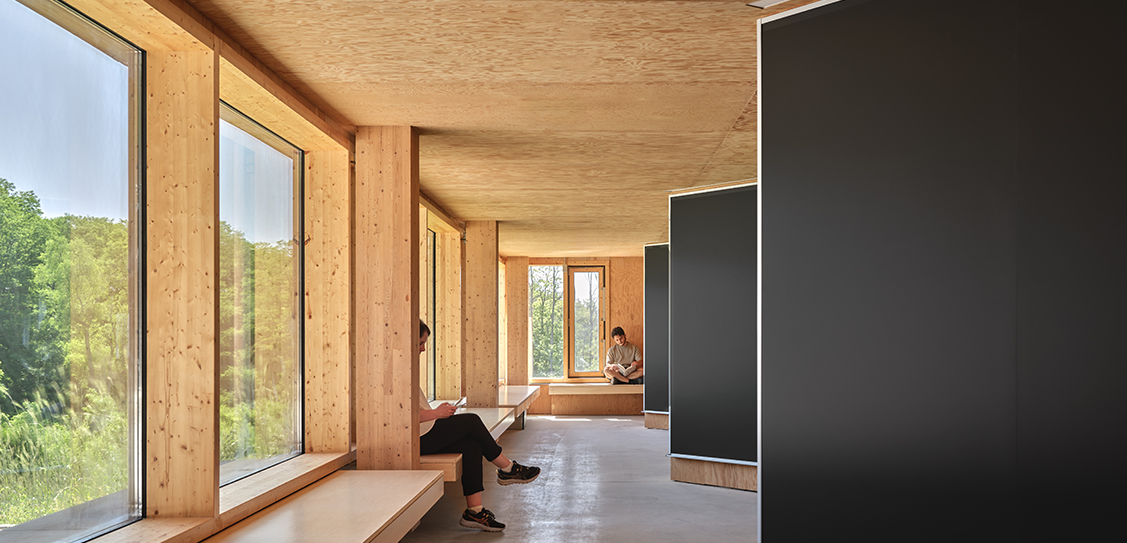
University of Toronto Koffler Scientific Reserve
Montgomery Sisam Architects
Client: University of Toronto
Copyright details: Photo credit: doublespace photography
Located north of the city of Toronto, the Koffler Scientific Reserve is a major venue for research and instruction in ecology and environmental biology at the University of Toronto. Supported by the complex ecosystem of the Oak Ridges Moraine, it offers students an opportunity to move beyond the classroom to the actual practice of science. The 800-acre property was bequeathed to the university after having been a country estate for much of the 20th century, and includes meadows, woodlands, watercourses and lakes. The site also contains remarkable geological formations, including some of the most noteworthy examples of drumlins and eskers in southern Ontario.The new building accommodates research students and faculty for extended periods of time. Modelled after a university quad, it is comprised of sleeping and bathing quarters, a refectory, living areas and teaching spaces. Nearby seasonal bunkies provide additional accommodation during the peak research season. The building takes the place of three aging barns. Its massing is inspired by agrarian building forms, adapted to include lanterns for natural light, overhangs for appropriate solar response, covered walkways, and a courtyard. The Dining and Operations Centre with its exposed timber structure is the social heart of the Reserve — a place to gather, to share, to enjoy. Views in and out of the building reinforce a sense of openness and transparency. The design reinforces indoor-outdoor connections: this is a building for people who love to be outside, working in the field. The form and material palette are an interpretation of the agrarian architecture typical of the surrounding landscape. Materials are selected not only for their aesthetic appeal and contextual relationship, but also for their contribution to sustainable goals. A superior building envelope is critical to achieving net-zero energy performance. The design solution includes SIP wall construction with Shou Sugi Ban wood cladding, walls at R-40 and a roof of R-60 insulation and thermally broken triple pane windows. The building utilizes a Passive ventilation design to reduce mechanical heating and cooling in the shoulder seasons. Operable windows achieve the airflow rates necessary to maintain indoor air quality and comfortable cooling during the summer. Supplemental heating and cooling is achieved through earth tube ventilation which provides year-round fresh outdoor air, prolongs the natural ventilation season, and significantly reduces the timeframes where the building requires active heating and cooling. Like breathable clothing developed for outdoor exploration, its timber structure is wrapped in a highly insulated skin that can be opened and closed in response to changing temperatures and weather conditions. The Koffler Scientific Reserve is targeting net-zero-carbon, net-zero-energy performance, and LEED Gold with full points under the LEED v4 Optimize Energy Performance credit. Renewable energy resources on site will produce 100% of the annual electricity required by the building. The Reserve’s operation will not emit greenhouse gases or use non-renewable fuel sources.