
Tom Delfim Moreira
Zien in collaboration with Gensler
Client: Gafisa
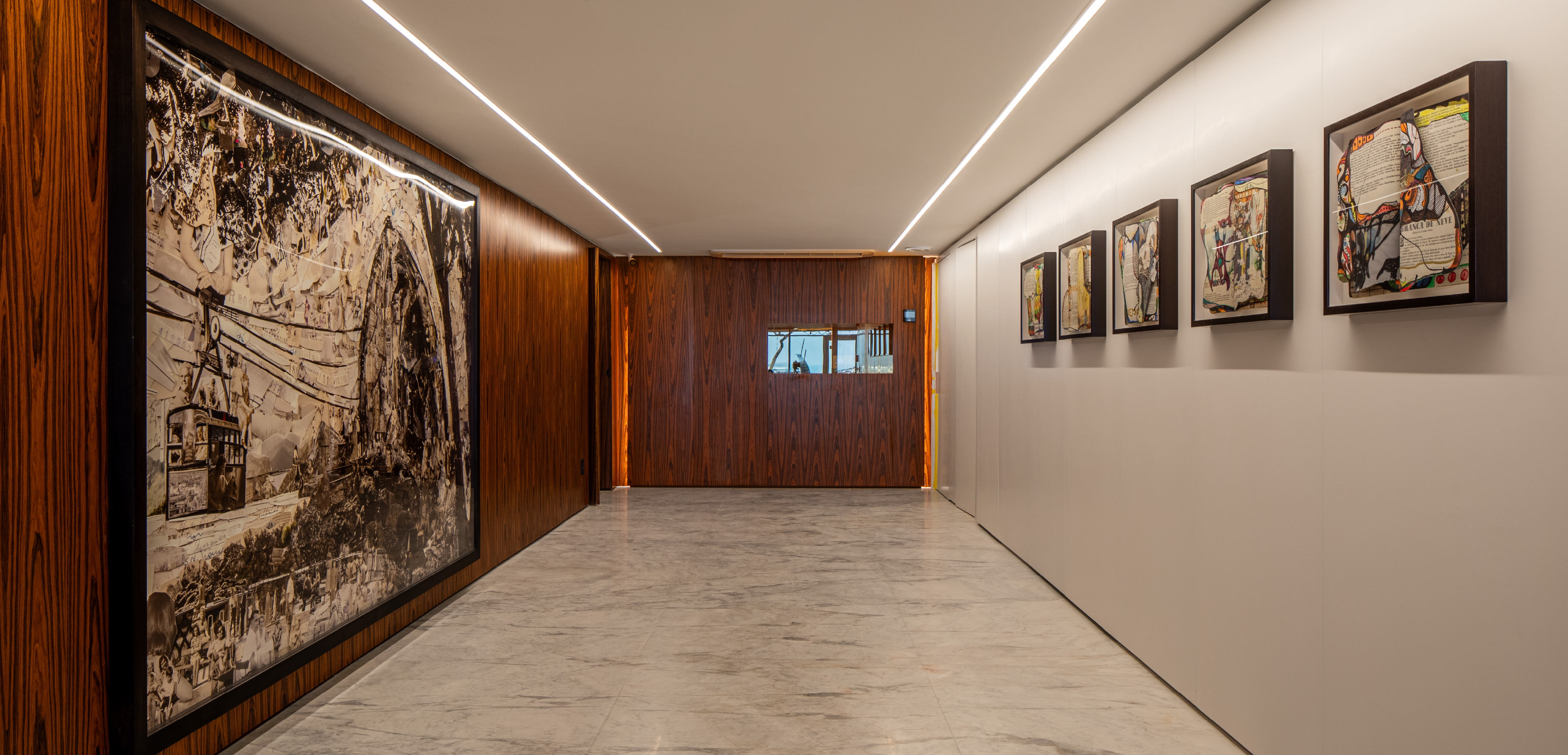
Another important factor was how the building would converse with the neighbors, from previous decades and from different styles. Our idea was not to imitate them, but also not to compete with them. Tom’s light and sinuous façade converses with the surroundings at the same time as it presents itself as something new, contemporary. Just as the Leblon neighborhood itself, which represents a balanced combination of elegance and simplicity, casualness and sophistication, urbanity and natural exuberance, the project’s architecture reflects the spirit of modernist tradition while also embracing the irreverence and contemporary character that have marked the renewal of architecture in Rio de Janeiro in recent years. For a smooth transition between interior and exterior, Burle Marx’s sidewalk design is extended into the building, honouring the iconic geometric patterns and creating a continuity between the sidewalk and the sinuous façade. One of the main concerns of the client (and ours) was to guarantee that the views would be a central element of each apartment. To capture the infinite ocean line, the lush nature, the Dois Irmãos mountain, Burle Marx’s sidewalk design, and a world-famous sunset, we maximised the horizon from within the building, making it feel as though the view flows into the apartment itself, framing the landscape, a well-known postcard of Brazil. Flexible floor plans, with structures and installations adaptable to different users allow each resident to express their individuality and transform the apartment into a true home. Another important challenge was to deliver a building made of materials that would withstand the harsh effects of the sea breeze while being comfortable and elegant at the same time. Our goal was to create an architectural language that is timeless, blending simplicity with technology. The façade is made of a composite product named Corian®, usually used for kitchen worktops but used here for the first time in Brazil in a residential building. Characteristics such as high resistance, non-porosity, uniformity, and thermoformability (which allows for precise, seamless joints) made it an ideal material for shaping the curvilinear terraces and, together with the nearly invisible transparent window frames, achieving an uninterrupted view. The interior finish of the terraces is made of Accoya wood, which is treated with an acetylation process, making it both durable and stable over the years. This soft materiality contrasts with the prefabricated elements and adds warmth and tactile comfort. Architecture is multidisciplinary, and this project gave us a broad opportunity to incorporate Brazilian contemporary art into our work. With curatorship of the agency Viva Projects, renowned Brazilian artists such as Iole de Freitas, Ernesto Neto, Sebastião Salgado, Vik Muniz, Campana Studio, Sonia Gomes, and Claudia Andujar complemented the design, displaying their works in both the lobby and the public walkway.