
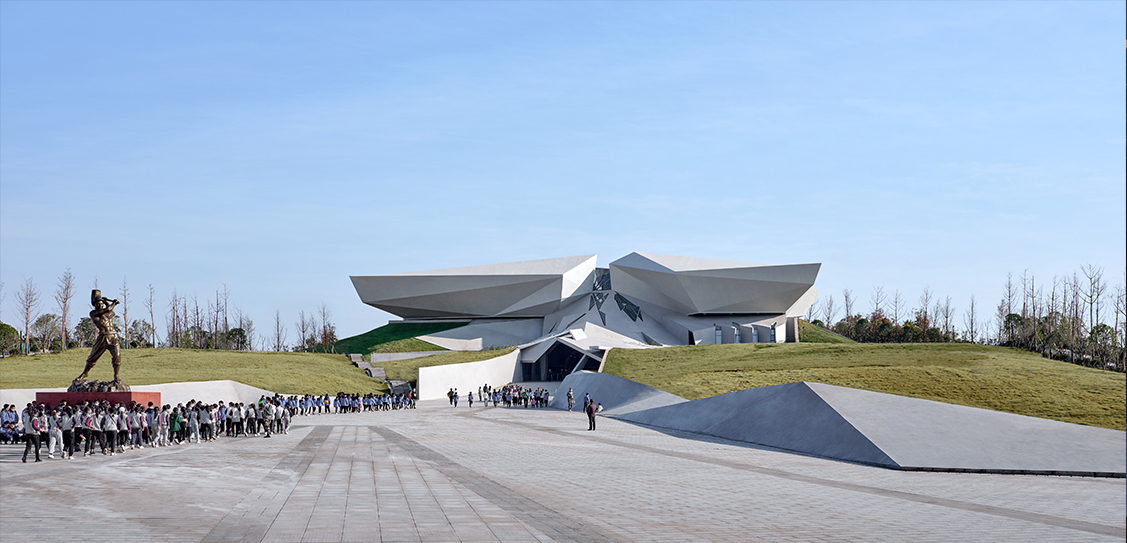
Shuikou Mountain Lead-Zinc Mine Site Museum
Yang Ying Design Studio of China Construction Fifth Engineering Division Corp.,ltd
Client: Hunan Shuikoushan Investment Holding Group Co., Ltd.
The museum is located on the park's highest hill, about 2 kilometers from the conservation area and over 4 kilometers from the new mining area. It forms the central point of an axis that includes the riverside entrance of the park, creating a 550-meter-long community plaza. By utilizing the park's mountainous terrain, the museum becomes a focal point that influences the overall spatial context of the site, allowing it to reconstruct temporal and spatial scenarios. The architecture takes on a bold and sculptural form, resembling a massive "ore" disrupted by an eruptive force. To achieve this, we opted for recycled concrete made from local slag waste as the primary material, allowing us to express our design intent and construction goals. Through the plasticity and unique qualities of recycled concrete, we incorporated variations in form such as segmentation, folding, creasing, and cracking. These elements were integrated with the plaza platforms, entrance pathways, and level differences, resulting in a monumental earth sculpture that mimics natural forces. This design evokes a distinct spatial tension and invokes connections to the historical and cultural significance of the lead-zinc mine. The interior spaces of the museum enhance the expressive approach by simulating the scenario of "mining tunnels of the lead-zinc mine." It incorporates characteristic elements like archways, footbridges, corridors, inclined bracing beams, and folded plates, aligning with the visitor's path. The design integrates turning staircases and elevators with exhibition spaces, creating a compressed and tensioned atrium. This arrangement forms a continuous and variable narrative space, offering a theatrical spatial experience. Visitors are immersed in an explorative journey that activates their imagination, empathy, and connection to the historical and cultural heritage. Since its completion, the museum has welcomed 3 million visitors, averaging over 3,000 visitors per day. It has become a prominent cultural landmark in the local area, offering a valuable space for residents, particularly the elderly and youth, to visit, learn and exercise. The site has deepened people's appreciation for historical and cultural heritage while promoting green, low-carbon, and environmentally friendly concepts. Additionally, it plays a vital role in promoting local cultural products and tourism, contributing to the region's economic and social development. The success of this project effortlessly achieves the social mission of architects in delivering knowledge through respectful, inclusive, and open spatial design inherent to museum architecture.