Shenzhen Science & Technology Museum
Zaha Hadid Architects
Client: The Bureau of Public Works of the Shenzhen Municipality
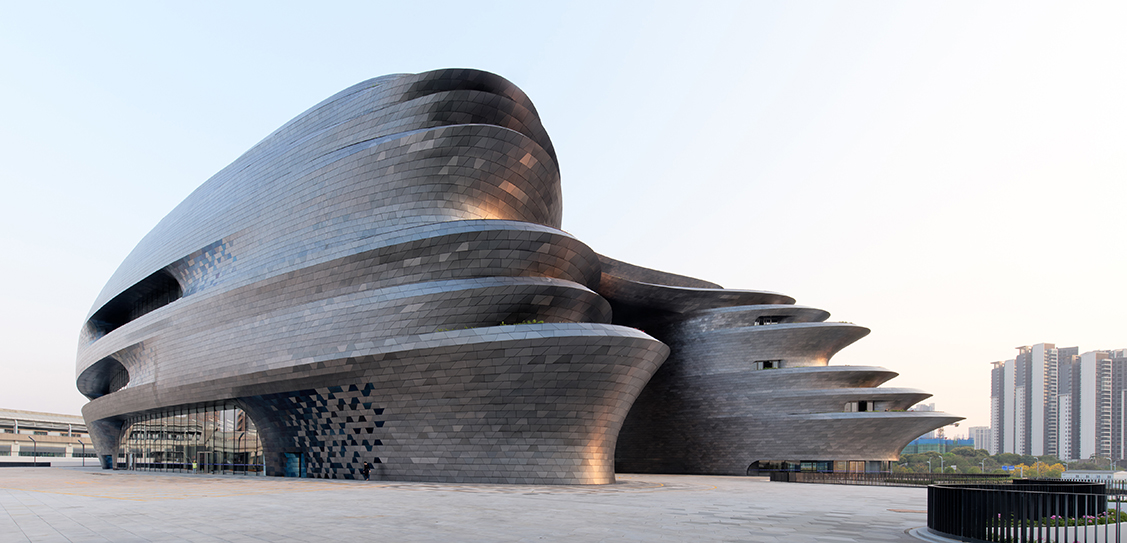
Adjacent to Guangming Station of Shenzhen’s metro network, the design responds to its location as a solid, spherical volume facing the city and defining the southeast corner of the new Science Park. Extending westwards into the park, the building’s volume stretches and transforms into a dynamic sequence of outdoor terraces overlooking the park. These terraces serve as functioning extensions of the interior galleries that define the grand central atrium, which has been designed as an important new civic space for the city. Guided by passive environmental strategies, the design process employed advanced computer simulations to test and refine the building’s form, spaces and envelope for optimal performance within the annual solar radiation, temperatures, humidity, prevailing winds, air quality & other variable conditions of Shenzhen’s subtropical climate and location. Targeting a three-star rating of China’s Green Building Evaluation Standard, the 128,276 sq. m museum’s passive design features combined with smart management networks operating high-efficiency systems are projected to reduce the building’s energy consumption to 15.47 kgce/sqm per year, subsequently lowering emissions from electricity demand to an estimated 125.89 kWh/sqm a year. The museum incorporates 35,000 sq. m of permanent and temporary exhibition halls and galleries, with 6,000 sq. m of immersive theatres and cinemas, as well as 5,400 sq. m of research laboratories, educational facilities and an innovation centre. Additionally, 34,000 sq. m of visitor amenities and storage join production and maintenance workshops. The many galleries within Shenzhen’s new scientific institution emerge from the floor and walls of its central atrium, while other galleries float above the awesome scale and composition of the atrium’s grand public space, each giving visual clues that intuitively direct visitors through the museum’s series of interconnected spaces. The atrium’s multiple perspectives and materiality also provide a thrilling launching point for every visitor’s journey of discovery. With its large, glazed wall facing the park, the atrium blurs the boundary between inside and out; inviting natural light and landscapes into the heart of the building. The museum’s façade features the first large-scale application of dual colour INCO technology in China. Precisely controlling an electrolyte formula and oxidation time, a nano-scale oxide film is generated on the surface of the steel, giving the façade a self-protecting, self-cleaning micro-layer that extends its life cycle by increasing resilience to weather and corrosion, while also enriching the stainless-steel with a fine texture and colour without any painting.