
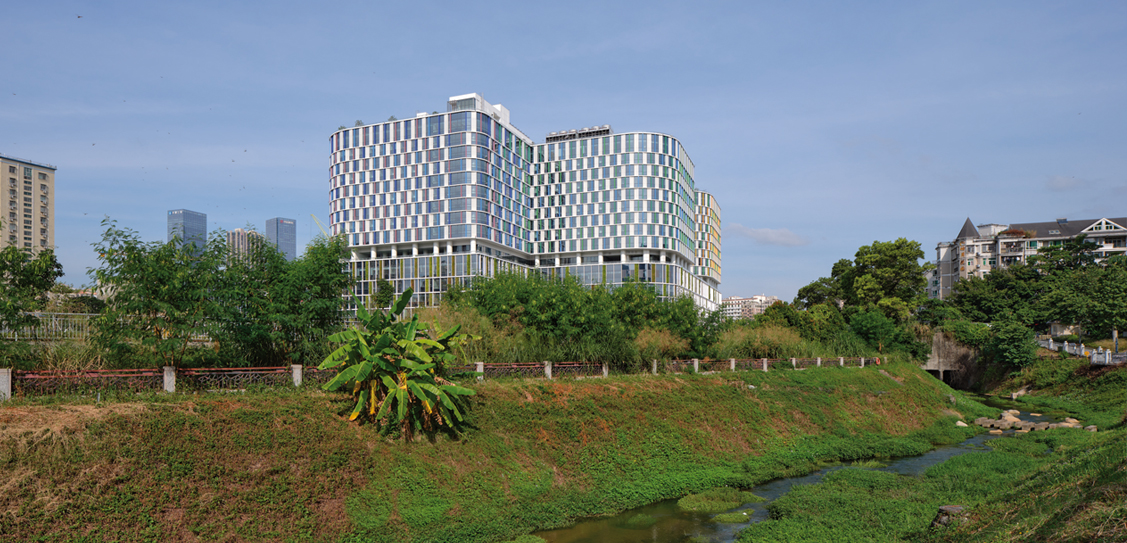
Shenzhen Children's Hospital Longhua Campus
Nickl & Partner Architekten AG
Client: Shenzhen Municipal Bureau of Construction and Public Works
Copyright details: Photo credit: Chaoying Yang
The Shenzhen Children’s Hospital Longhua Campus stands as a defining achievement in the evolution of pediatric healthcare within one of China’s most forward-looking cities. Conceived as a model for the integration of medical care, research, and innovation, the 360,000-square-meter facility accommodates 1,500 beds—twice the capacity of the original Futian campus. Strategically connected to the city via the Minzhi subway station, the hospital embodies a synthesis of healthcare architecture and urban infrastructure, reflecting Shenzhen’s rapid transformation into a global innovation hub.The architectural vision for the Longhua Campus rests on two guiding principles: clarity of organization and human scale. Despite its monumental size, the building maintains a legible and approachable structure. A prominent base volume houses diagnostic and treatment functions, while the upper levels rise into patient towers that maximize daylight and views. Between them, a landscaped intermediate level unfolds as a public green terrace—an open-air space that encourages encounters, relaxation, and play. Here, the hospital becomes more than a place of treatment; it becomes a civic landscape woven into the fabric of the city. Spatially, the design creates a rhythm of openness and intimacy. Large courtyards punctuate the complex, allowing natural light and ventilation to penetrate deep into the clinical core. These planted voids soften the hospital’s scale and provide a sense of orientation and calm. For patients, especially children, the presence of daylight and greenery has a profound therapeutic effect, reducing stress and fostering recovery. For staff, the same design gestures contribute to a humane and uplifting working environment—an often-overlooked aspect of hospital architecture. The hospital’s role extends well beyond medical care. Publicly accessible spaces such as cafés, shops, and community facilities transform the ground level into a vibrant urban commons. The entrances, articulated as generous forecourts, serve as neighborhood squares, linking the hospital seamlessly to the surrounding district. In doing so, the Longhua Campus challenges conventional notions of healthcare architecture as isolated or introverted, positioning itself instead as an integral part of the urban ecosystem. Operationally, the hospital meets Shenzhen’s growing healthcare demands with remarkable efficiency. Designed to serve up to 10,000 outpatients daily, it exemplifies how thoughtful spatial planning can streamline complex medical workflows while preserving comfort and dignity. Specialized centers—dedicated to allergies, sleep medicine, and sports rehabilitation—illustrate a commitment to comprehensive, interdisciplinary care. Meanwhile, design details such as an underwater-themed anesthesia room introduce an element of imagination, transforming moments of anxiety into experiences of reassurance and wonder. Architecturally, the Longhua Campus embodies an international and optimistic spirit. Its language of openness, lightness, and greenery resonates with Shenzhen’s progressive urban identity. More than a hospital, it represents a holistic environment where architecture, medicine, and community intersect. The result is a place that not only provides care but also cultivates resilience—a building that offers hope, provides comfort, and strengthens children on their path to recovery.