
Shangshan Heritage Museum
The Architectural Design & Research Institute of Zhejiang University Co., Ltd. (UAD)
Client: Zhejiang Pujiang Shangshan Daoyuan Construction Co., Ltd.
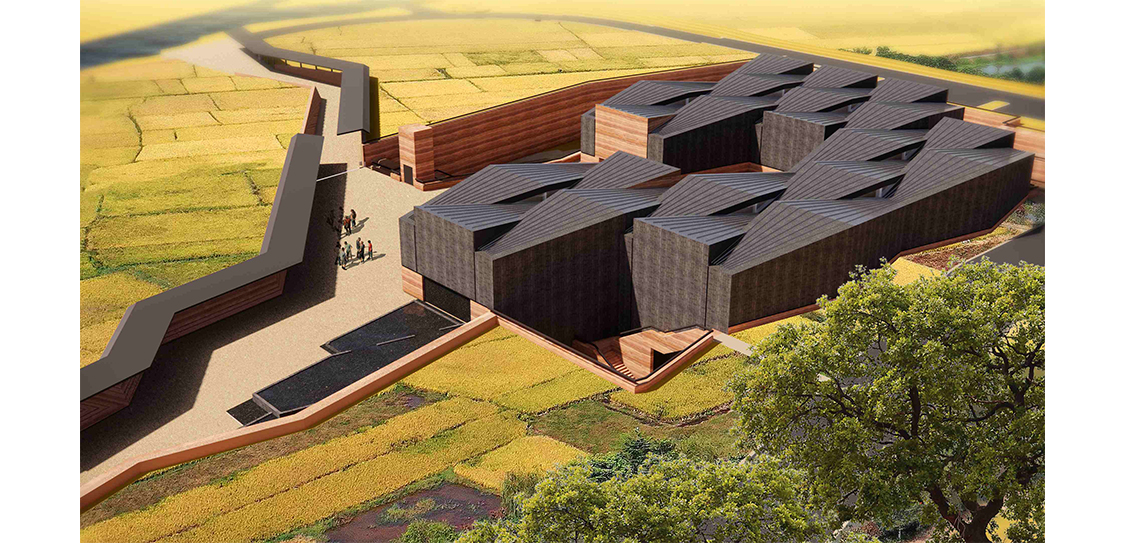
Our ancestors once sowed rice seeds and harvested grains here. Currently, the major challenge is to integrate this "new" museum into the "original" land. Out of respect for the original ecological environment, the design team employes modern construction techniques and ecological material technologies and the natural landscape to create a place where the past and the present converge. To reduce the impact of the museum on the overall appearance and echo the architectural texture of the surrounding villages, the design breaks down the building volume into smaller parts. The museum is lowered by 2 meters to blend into the surrounding landscape while ensuring sufficient exhibition hall height. The design significantly lowers the height of the museum and buries more than half of the functional spaces deep underground, so that the exposed part can harmonize with the scale of the surrounding natural landscape. The cultural relics research area and the collection storage rooms, located on the first basement floor, are connected to the outside through three sunken courtyards, ensuring a quiet research environment and natural light and fresh air. The building adopts a special steel-reinforced concrete shear wall structure, and the imposing and stable exterior shell highlights the long history of the Shangshan Culture and provides the necessary structural strength for the large-span, column-free exhibition space inside. Considering cultural relic protection, the above-ground space of the museum does not have exterior windows, and the entire building is covered with panels featuring the textures of carbonized wood and rammed earth. This design blurs the boundary between artificial objects and naturally grown ones, making the museum seem to have gained life and been integrated with the earth as one. Meanwhile, the architects embed local handcrafted pottery shards on the lower exterior walls, allowing visitors to experience the dance of fire and earth and listen to the dialogue between life and nature. The Shangshan Heritage Museum serves as the carrier for protecting and showcasing the Shangshan Ruins, and it is also a modern public building that integrates education, experience, and research. This design concept highlights the long time span and historical significance of the ancient civilization, and conveys to successive generations of visitors the philosophical idea of "harmonious coexistence and continuous existence" with nature.