SAP Labs India Innovation Park
RSP India
Client: SAP Labs India Pvt Ltd
Copyright details: Photo credit: Lokesh Dang
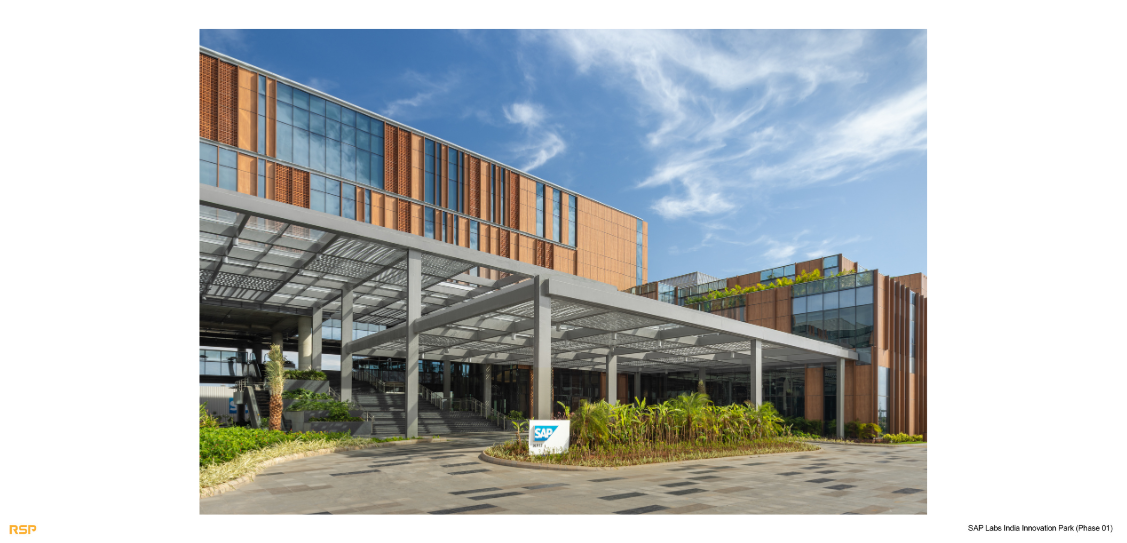
SAP India Innovation Park establishes a new benchmark for corporate real estate development. Conceived through a national design competition, this 41-acre LEED Platinum pre-certified campus functions as a net-zero, water-positive, and carbon-neutral development.The proposal integrates a user-driven programmatic system with culturally informed strategies and robust sustainability measures, establishing a coherent spatial narrative that aligns the project with its environmental and contextual conditions.The campus is envisioned through a forward-looking framework shaped by six guiding pillars—sustainability, context, placemaking, diversity & inclusion, mobility, and serendipity. Designed for a post-pandemic world, it prioritizes collaborative environments and a non-hierarchical spatial character. The result is a network of activated, walkable spaces that strengthen social exchange and reinforce a strong sense of place - a vibrant, people-centric environment. A key design gesture is the north–south orientation of the major built forms—an environmental strategy that minimises solar exposure. This passive response reduces heat gain and enhancing overall energy efficiency. The masterplan is structured around two primary spines—Social and Green—that intersect to anchor key amenities and unify the campus. This dual-axis framework weaves together social activity and ecological performance, ensuring that movement, landscape, and built form operate as an integrated whole integrating a 35,000-square-foot biodiversity rich landscape. In the first phase of development, Buildings B1 and B3 are conceived as dynamic hubs, while Building B2 anchors the ceremonial plaza with a 300-seat auditorium supported by dedicated innovation and training facilities. The workplace ecosystem is further enabled by a network of ancillary amenity nodes—including a cafeteria, visitor experience centre, multi-modal transit hub, a sports arena, Fitness & health centre and a dedicated crèche. A climate-responsive façade strategy forms the foundation of the project’s sustainability approach. At the ground level, buildings open into the landscape through shaded colonnades—breezeways that function as social edges and primary circulation corridors. The upper levels are articulated with stepped massing that reduces heat gain and glare, while creating terraces and sheltered courtyards that promote outdoor engagement. High-performance surfaces, including sintered panels and vertical fins, further mitigate glare while maintaining transparency and outward views. Locally sourced terracotta jaalis add depth, texture, and rhythm, reinforcing a material palette rooted in regional identity.Water stewardship is central to the pursuit of a net-zero campus. The development meets its full water demand through rainwater harvesting, treated wastewater reuse, condensate recovery, and groundwater recharge. Energy efficiency is achieved through advanced HVAC systems like Radiant baffles in office spaces and HVLS fans in larger volumes significantly reduce cooling loads throughout. The campus’s energy requirement is generated through rooftop solar arrays and hydrogen fuel cells. The back-up energy network replaces fossil fuel-based Generators with Battery Energy Storage Systems (BESS). Inclusivity is embedded holistically in the design—from accessible pathways and ramps to sensory rooms, lactation spaces, and tactile braille signage—ensuring that the campus offers an equitable and dignified environment for all users. Through its ensemble of communal plazas, landscaped courts, and shaded verandas, the campus cultivates a harmonious dialogue among nature, mobility, culture, and technology. The result is a humane, future-ready innovation hub that balances ambition with sensitivity and scale with experience.