
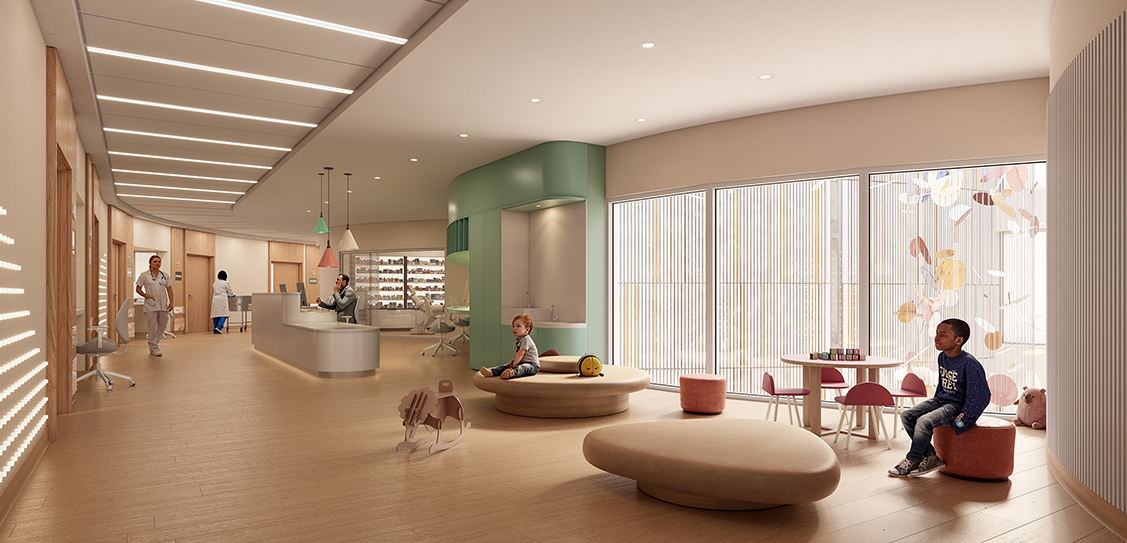
Sabará Children's Hospital
Perkins&Will
Client: Hospital Infantil Sabará and SDI Desenvolvimento Imobiliário
A national reference in pediatric healthcare for over 60 years, this non-profit institution combines medical excellence, innovation, and a deeply human approach to each patient—and their family. With a history of positively impacting the lives of thousands of children, the hospital is entering a new phase: one of updating and expansion, increasing its care and treatment capacity. The new hospital follows the premise that children are individuals in a developmental stage and, therefore, require space and processes that help them reach their full potential. Its organic, rational, and responsive design takes advantage of the surrounding conditions to offer the best experience, beginning with the building's connection to the surrounding streets: while Avenida Rebouças emerges as one of São Paulo's main and busiest thoroughfares, Rua dos Pinheiros recaptures the neighborhood's calmer atmosphere, with greater pedestrian flow taking advantage of the area's infrastructure. These characteristics influenced the building's design, from the entrances to the organization of each floor. Following Sabará's philosophy, we developed a program that welcomes children, families, and healthcare professionals. The project includes spaces for activities focused on child growth, promoting stimulating experiences, and ensuring the well-being of all professionals. The new Sabará will have 42,000 sqm, spread over 22 floors: 4 basement levels for parking and logistics areas, and 18 above-ground floors, housing administrative spaces and diagnostic and treatment facilities. The project's relevance is reflected in its materiality. Glass panels cover the entire exterior, punctuated by vertical brise-soleil that controls natural light in the interiors and give identity and rhythm to the facade. These lines interact with the columns on the ground floor—a double-height space—where the pilots create a wide, permeable roof for pedestrians and equally inviting for vehicle boarding and disembarking. A central atrium cuts through the building vertically, passing through all floors, from the ground floor to the top. Like a tunnel connecting earth and sky, or a portal to another dimension, this element also establishes visual relationships between floors, intensifying people's connection with each other and with nature. These features provide abundant natural light and effectively integrate with the exterior landscape. They also adhere to the principles of humanized design, which characterize the entire project, from the choice of coverings to the use of playful elements at different scales. The building's integration with nature is a fundamental pillar of its design, with benefits linked to sustainability and user well-being. Our studies and evaluations of previous projects demonstrate that this strategy, combined with the optimization of flows and family support structures, has a direct impact on the evolution of patients' health conditions.
The new Sabará Children's Hospital is the result of a partnership between Lara Kaiser and Manuel Cadrecha in design leadership and is being realized thanks to the efforts of Afonso França Engenharia, responsible for the construction of the project.