
Regional Urban Renewal of Chengdu Pengzhou Longxing Temple Area
BIAD-ASA Studio
Client: Chengdu Mengjiang Investment Group Co., Ltd.
Copyright details: Photo credit: arch-exist
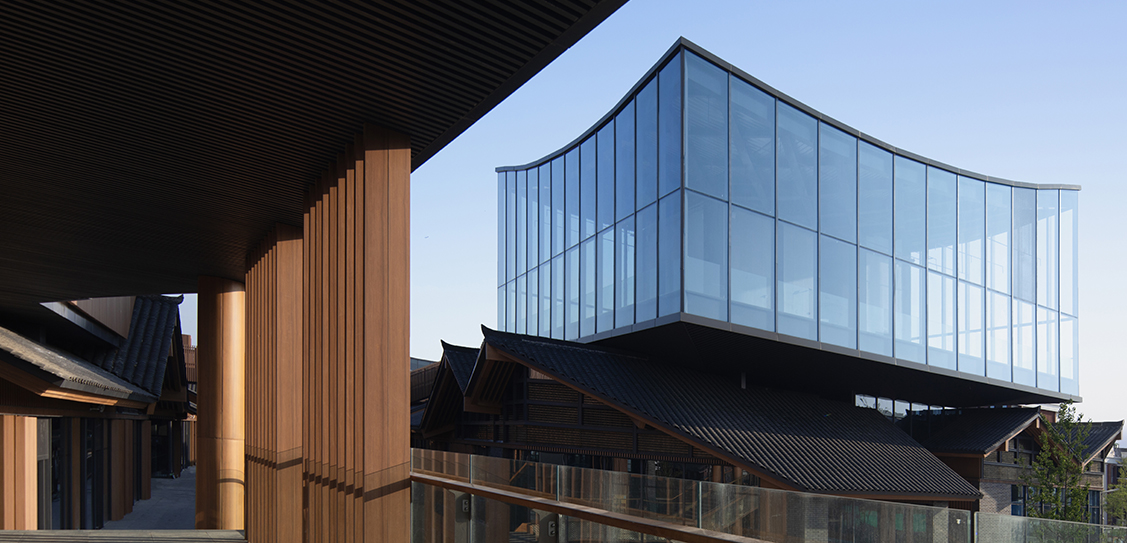
The project is situated in the heart of Pengzhou's old town, historically the most vibrant area in the city. Addressing the area's deficiency in public facilities, BIAD-ASA Studio introduces a mix of commercial and cultural functions, including retail spaces, dining establishments, hotels, an art gallery, a library, an exhibition hall, a civic activity center, and an urban park plaza.This integration is achieved through a network of water features, streets, and sky-walks, collectively reimagining the charm of a traditional Sichuan lifestyle and fostering a renewed sense of cultural identity and belonging for the local community.Inspired by traditional Chinese urban imagery, the design incorporates three representative elements into its identity and spatial organization: the “Ten-sided Bushes of Buddha,” “Sloped roofs,” and “Skyline in Memory.” The layout adopts the concept of the "Ten-sided Bushes of Buddha" with the temple serving as the central focal point. North stands a museum that exceeds the height of the temple buildings; south an open forecourt; east a repurposed green space created from a disused factory; and west a flowing water feature integrates with the area; The "Sloped roofs" reminiscent of Pengzhou's 1990s urban imagery, are reinterpreted as independent public spaces, interlinked by aerial walkways and platforms that traverse the site. Three-story primary buildings evoke the traditional style of residential and commercial structures; In contrast, larger cultural buildings feature upturned eaves and take inspiration from temple bell towers, collectively creating a dynamic " Skyline in memory". The design harmonizes key pedestrian public spaces with layered landscapes offering changing vistas. A gently ascending aerial corridor surrounds a tranquil water surface, with building heights intentionally reduced in proximity to the water to enhance the visual experience. Landscape courtyards extend the connection to the water, while the historic "Longxing Street," dating back to the Qing Dynasty, is preserved in its original alignment and scale through a sunken design approach. The climate in Pengzhou is warm in winter and hot in summer, and the elderly people especially enjoy in outdoor activities. We design a Curved-water corridor for them to relax and rest for a while. “Osmanthus Street,” located south of the temple, has been revitalized as a vibrant food street, rekindling the city’s cultural memory and bustling atmosphere. Historical buildings on the site have been assessed based on their heritage value, with preservation strategies tailored accordingly. Restored structures honor local traditions through their forms and materials. For the typical buildings in this project, we adopted the column and tie structure and gable walls texture,which are the tradition architecture style in western Sichuan. However, in the construction process, the bamboo materials were replaced by aluminum materials with the same color due to the strict fireproof regulations. Ultimately, the design achieves a balance between modern architectural functionality and the creation of intimate, human-scaled spaces offering a contemporary interpretation of traditional spatial concepts. This project redefines urban center, blending historical context with innovative urban planning.