
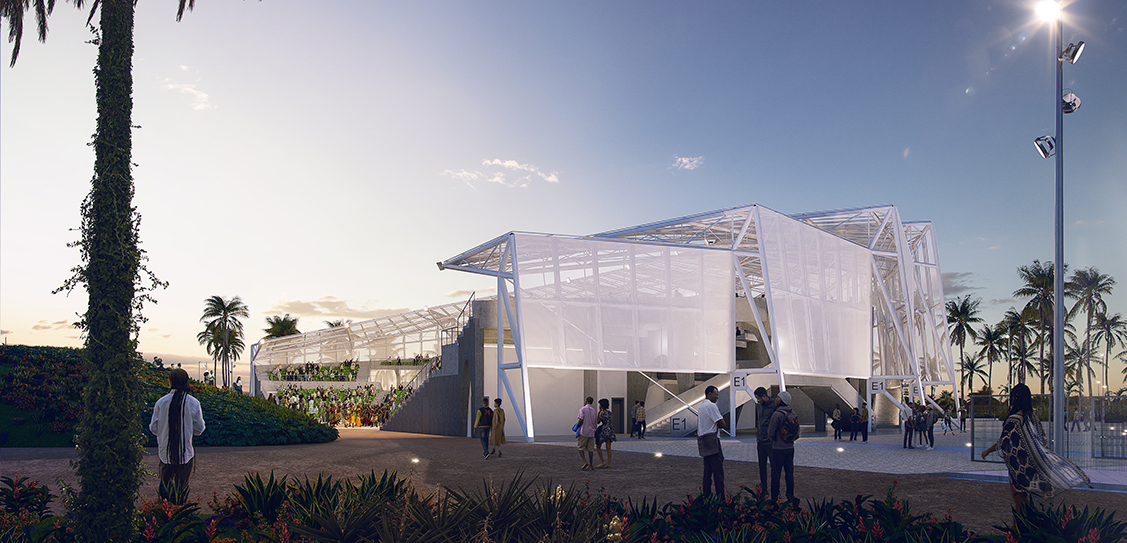
Porto Novo Cultural Arena
StudioMAAC
Client: SIRAT + Ministry of Living Environment and Sustainable Development
Lead Architect: Stephane Cottrell, John Hick, Gonzalo Pardo
Located at the entrance of Porto-Novo, on the bridge linking the capital to Cotonou, the Cultural Arena is conceived as a new urban landmark — a civic and cultural beacon for Benin’s capital. The brief called for an open, inclusive, and flexible venue capable of hosting large public events while asserting a strong identity rooted in place. The challenge was to design a sustainable structure accommodating up to 6,000 seated spectators, integrating seamlessly with its sensitive riverside context and urban fabric.At its core, the project responds to the idea of the arena as a place of gathering — a space for the community to come together and celebrate collective identity. The program is deliberately plural: it must host concerts, artistic performances, festivals such as the Vodun Days, and civic occasions like public addresses or assemblies. Its flexibility allows the same structure to adapt to multiple configurations, from major performances to more intimate gatherings and everyday uses. Through this versatility, the project aspires to become one of Porto-Novo’s most inhabited and vibrant public spaces. The site’s position between the river and the main gateway to the city gives the Arena both symbolic and urban significance. More than a performance venue, it acts as a generous public space: an open esplanade to the north provides access to the stands, while a landscaped parking area to the south connects to the riverbanks. This configuration transforms the site into a social and ecological interface — a place for walking, leisure, and informal gatherings that strengthens the link between city and river, architecture and landscape. Architecturally, the design balances monumentality and lightness. Prefabricated concrete bleachers rest on a grid of exposed concrete walls and arches, expressing strength and permanence. Above them, a light steel structure supports a 25-meter cantilevered textile façade and roof. This combination of robust and delicate materials reflects both the durability expected by the client and the ambition to minimize environmental impact. The textile canopy and façades recall the Ouidah Marina Arena, establishing continuity within Benin’s emerging network of cultural infrastructure. Sustainability lies at the heart of the project. From the outset, the design sought to reduce its carbon footprint through prefabrication, local materials, and efficient construction. Precast concrete, high-performance steel frames, and lightweight textiles cut waste, shorten construction time, and lower transportation emissions. By sourcing locally and involving local labor, the project supports regional economies and reduces embodied carbon while fostering community ownership. Passive strategies further enhance energy performance: the open structure promotes natural ventilation, cross-breezes, and shading, eliminating the need for mechanical cooling. The surrounding landscape, planted with native species, limits irrigation, filters stormwater, and mitigates heat gain. Together, these measures create a resilient, climate-responsive environment that ensures comfort through orientation, airflow, and vegetation rather than energy-intensive systems. In sum, the Porto-Novo Cultural Arena meets the client’s ambitions — flexibility, accessibility, sustainability, and identity — through an architecture that is both grounded and open. It stands as a unifying landmark where culture, nature, and community converge, embodying a contemporary vision of Benin’s urban and cultural vitality.