
Palmerston Street House
Robert Simeoni Architects
Client: PP Pty Ltd
Copyright details: Photo credit: Trevor Mein
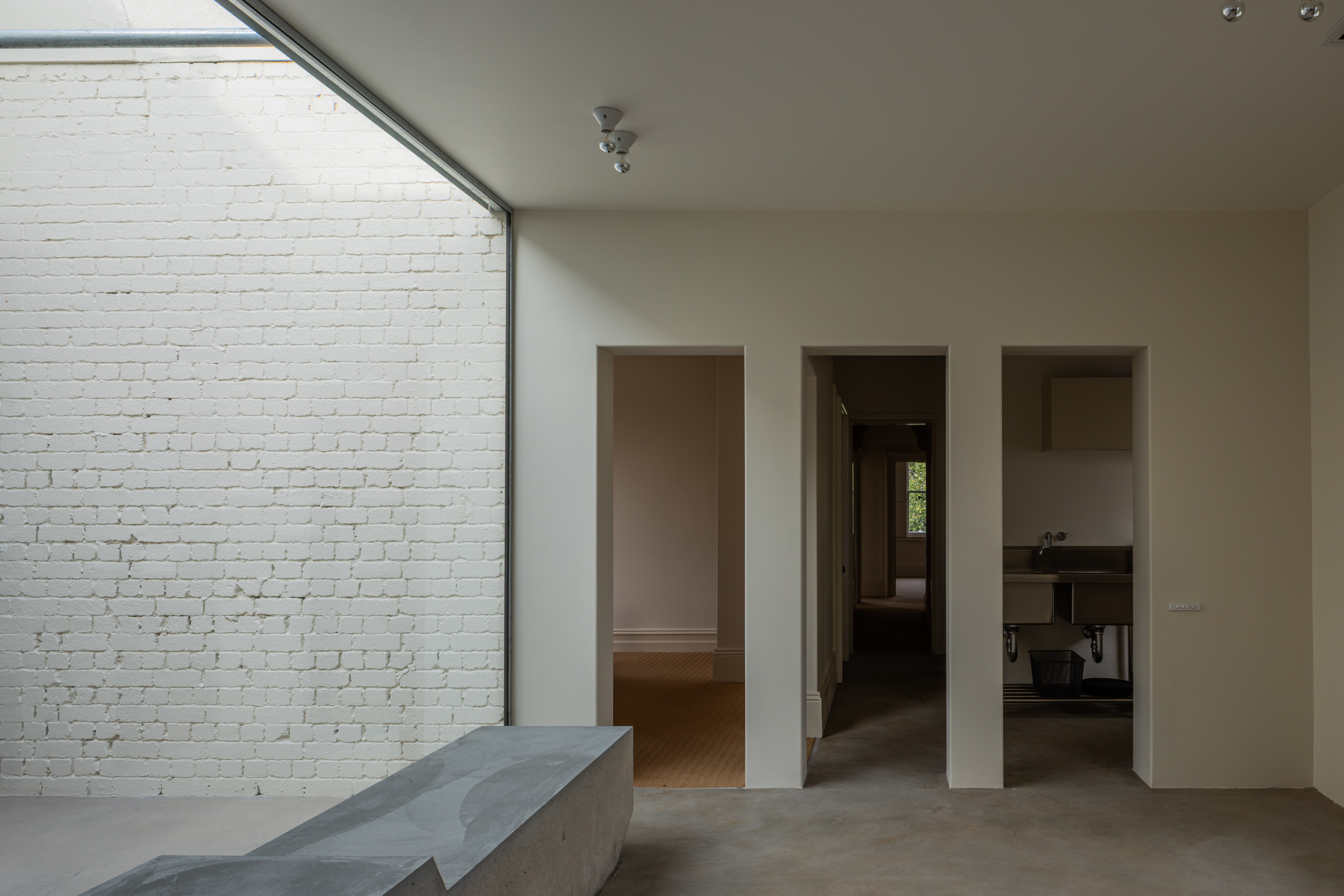
Palmerston Street House stands amongst other remnants of 50s and 60s alterations in the Carlton area undertaken by European migrant occupants. Born of necessity, they are often characterized by the skilful use of sturdy materials such as concrete, bricks, and mortar, reflecting a ‘builderly’, yet poetic quality. Some of these things appear ad-hoc and unusually proportioned, even awkward, but looking closer they have a weight, honesty and beauty of their own. These are often simple solutions to programmatic or spatial problems but are also often much more.There is poetry here in the robust, builderly quality of the forms and the labour invested in them. They are by no means expedient or temporary and arise from the needs of growing families at those times. This project found keen inspiration in these dwellings, and together in response to a tight budget, a programme of adaptive reuse was pursued. Though significantly altered by years of ‘builderly’ intervention, the house at Palmerston Street had remained largely undiminished in presence and projection to the street. Honouring this resilience, it was decided our response would be deliberately interior only and leave the house, at first glance, untouched from the street. Glimpses of change, such as an upstairs terrace, or concrete bathroom below, are revealed only at second or third passing, depending on the direction of the sun or a reflection on a window. Intended to be used as a home and office space respectively on each of the two levels, existing spaces were re-examined in light of their newfound context, considering their multifunction potential: A garage became a space to sit and meet, not just somewhere to park a car - an upstairs bedroom became a concealed outside terrace with existing roof removed, introducing northern light and views of the park opposite to the new and unexpected living space. The stratified sense of the Victorian building was similarly rethought to allow greater vertical connection. Requiring a direct and parsimonious approach to material selection, detail and complexity of construction, the project curiously aligned with the direct approaches of past immigrant work. The building’s needs were met with an immediacy and austerity, where the selection and quality of materials evinced their meaning in construction. Fixtures and fittings were selected ‘off-the-shelf’, using unexpected products, such as cyclone-wire mesh and acrylic wall panelling, in new ways. Hardy materials were likewise selected for their quality, yet utilised in a way which evinced their sensuous nature, such as a concrete plinth next to a sisal carpet, or plain tiling alongside fluted glass in the bathroom. With this ‘direct’ approach to materiality, the use of light was particularly important, valued almost as a material in itself, in curating atmosphere throughout the house. A series of voids, downlights and particularly, concealed skylights were carefully positioned to ensure a softness of light and feel to the interior, as in a glazed void upstairs, carrying through two levels to share light to a corridor and bathroom on the first floor, and a fallow space at ground.