
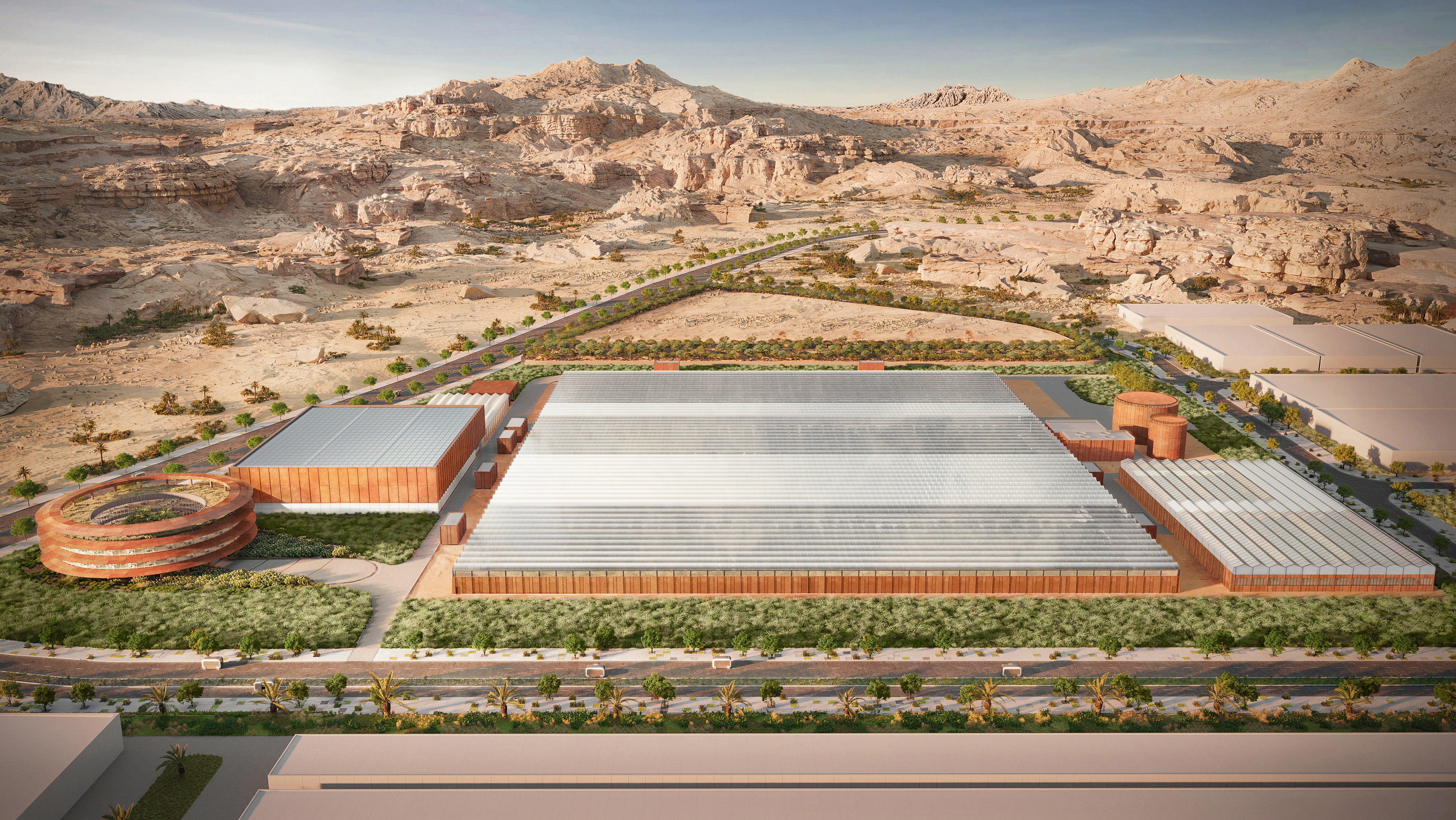
Oxagon Agricultural Complex
Andre Kikoski Architecture
Client: NEOM
Situated on a 40-acre desert site, the 11-acre greenhouse is anticipated to produce 1,972 tons of fresh fruit and vegetables annually. Through advanced strategies that deliver up to 93% water savings compared to traditional agriculture -- and 50% compared to other hydroponic systems -- the project offers a replicable model for climate-resilient food infrastructure. The complex supports NEOM’s ambition to ensure food security and self-sufficiency in a region expected to be among those most affected by increasingly extreme climate conditions. AKA master planned the site, designed the structures, and developed the site-wide landscape strategy. The complex includes a half-million-square-foot primary greenhouse, a 21,500-square-foot circular office building, and a vertical farm, along with ancillary energy rooms, cooling towers, and storage tanks. The master plan occupies a prominent site along the perimeter access road into Oxagon, showcasing Topian’s vision while reinforcing its goals for both visitors and team members. The circular office building anchors the site composition and provides sweeping views over the entire campus. The greenhouses employ urban farming techniques specifically designed for arid climates, including a seawater-based cooling system and data-driven growing solutions that significantly reduce water and fertilizer usage. This sustainability-forward approach is powered by photovoltaic arrays and passive cooling strategies, reflecting a net-zero design ethos applied across all program elements. The project team includes Netherlands-based Van der Hoeven Horticultural Projects, a global leader in horticultural infrastructure. Architecturally, the design invokes a sense of the future while remaining highly efficient and resource-conscious. The façades are expressed through a minimalist language of horizontal reveals and vertical fins that emphasize economy and functionality while humanizing the scale of the structures. A palette of unembellished, utilitarian materials -- including insulating sandwich panels, shot-peened aluminum, textured Corten-steel finishes, and precast concrete -- produces an elevated industrial architecture with an unexpected sense of visual poetry. The landscaping emphasizes harmony with nature, using native grasses to soften the boldness of the architecture and anchor the complex within its dramatic desert setting.