
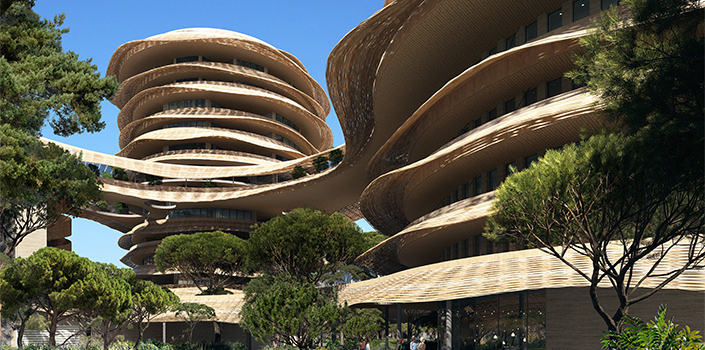
Oasis
Coldefy
Client: Sogeprom-Pragrma
The development brings together housing, offices, shops, and a generous public garden into a single, coherent composition. In response to the Mediterranean climate, Coldefy conceived two undulating buildings crowned with bioclimatic bamboo “umbrellas,” recalling the protective gesture of a straw hat or sunshade. These structures result from an interplay of environmental engineering, computational form-finding, and structural optimization. Their organic geometry reduces solar gain during the hottest months, limiting the need for active cooling and supporting high energy performance. Inside the buildings, apartments benefit from double or even triple orientations, maximizing natural light and cross-ventilation. This passive design strategy is complemented by the use of biosourced and geosourced materials throughout. Bamboo, sourced locally from a grove in Anduze, was chosen for its durability, rapid renewability, and low environmental impact. Its use reinforces short supply chains while aligning with Oasis’s ecological ambition and its commitment to sustainable, regionally grounded architecture. The project is also nourished by the childlike imagination of the treehouse, evoking an immediate sense of pleasure and plenitude. The footbridge linking the two programs—like a suspended walkway among the treetops—and the giant slide connecting it to the heart of the block enrich this joyful, wooded universe. Vegetation is conceived as a catalyst for social interaction. The garden at the center of the development becomes a shared living space, an inviting meeting point animated by its lush planting—where residents, passers-by, children, and users naturally converge. Social link is further encouraged by the footbridges, which create both physical and symbolic connections between different functions and communities within the project. As a result, boundaries between uses intentionally blur, fostering an inclusive and generous environment where people cross paths around the project’s distinctive landmarks: the central garden, the Canopy, and the Peaks. As the final piece of the Ovalie district, Oasis becomes both a gateway and a destination: a place where architecture grows from the landscape, where nature shapes community, and where a new Montpellier skyline emerges—soft, welcoming, and open to discovery.