
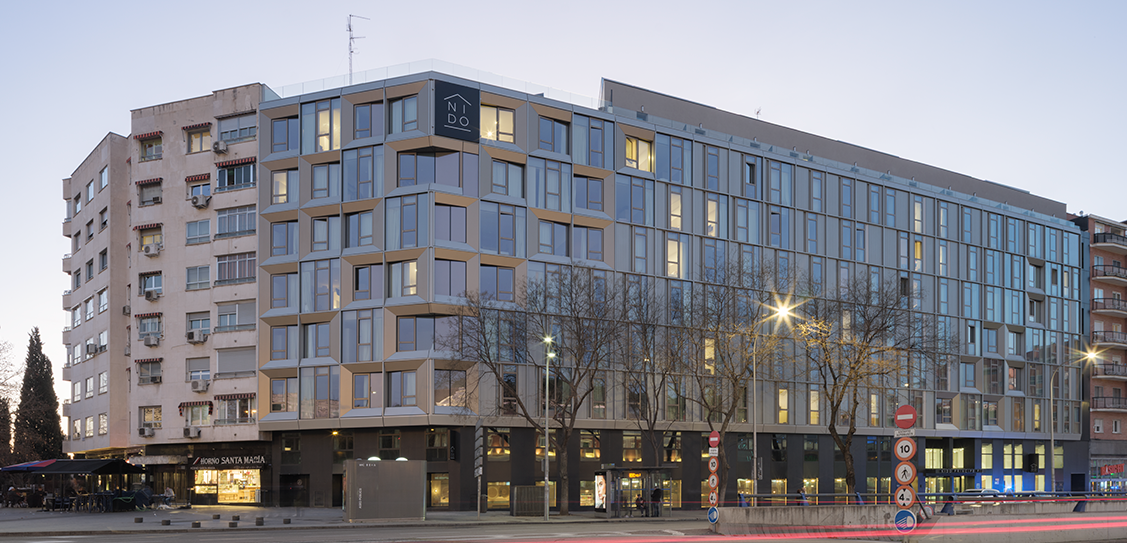
Nido Principe Pio
Morph
Client: FindNido
Copyright details: Photo credit: Pegenaute
Nido Príncipe Pío: Reframing Heritage Through Façade InnovationNido Príncipe Pío illustrates how a carefully considered façade strategy can transform a disused heritage structure into high-performance, contemporary housing. Designed by Morph in collaboration with Construcciones Ruesma and FindNido, the student residence in central Madrid sets a precedent for how façades can connect architectural legacy with technical precision and sustainable construction. The project sits within a highly sensitive heritage zone (APE 001) and preserves the shell of the former Hotel Florida, a building listed for its historical value. Rather than replicating the past or concealing it, the new façade draws on the original proportions, rhythm, and material presence, reinterpreted through a bespoke prefabricated system. This off-site system became both the architectural and technical cornerstone of the project. Developed before full access to the existing structure was possible, it relied on early structural surveys that allowed accurate design and fabrication to advance in parallel with interior works. The result was a controlled and low-impact installation process, enabling 6–10 panels to be placed each day with minimal noise, dust, or disruption. The prefabricated panels were designed not only for speed and precision, but also to enhance thermal and acoustic performance, durability, and ease of maintenance. Their scale, rhythm, and vertical emphasis echo the original façade while upgrading the building envelope to achieve BREEAM “Very Good” standards. In this way, the façade delivers a refined contemporary identity that integrates seamlessly with its historic surroundings. Given the site’s constraints—including a single access point, crane restrictions, and neighbouring heritage buildings—prefabrication was vital. Demolition was carried out manually via stairwells, and external scaffolding time was strictly limited. The façade strategy therefore addressed not only aesthetics but also construction logistics. The project also benefited from an integrated delivery model. With Ruesma acting as both contractor and development partner, design, fabrication, and construction were closely coordinated. This collaborative approach secured civil and heritage approvals in just seven months—a rare achievement in such a complex urban setting. Ultimately, the façade at Nido Príncipe Pío succeeds on multiple fronts: it honours heritage without imitation, improves performance without compromise, and enables construction without disruption. More than an envelope, it is an enabler—acknowledging the building’s past while ensuring its future. In a city where heritage and progress often collide, this project demonstrates how façade design can unlock sustainable urban reuse. Intelligent prefabrication, contextual sensitivity, and architectural clarity make Nido Príncipe Pío a model for the adaptive envelopes of tomorrow’s historic cities.