
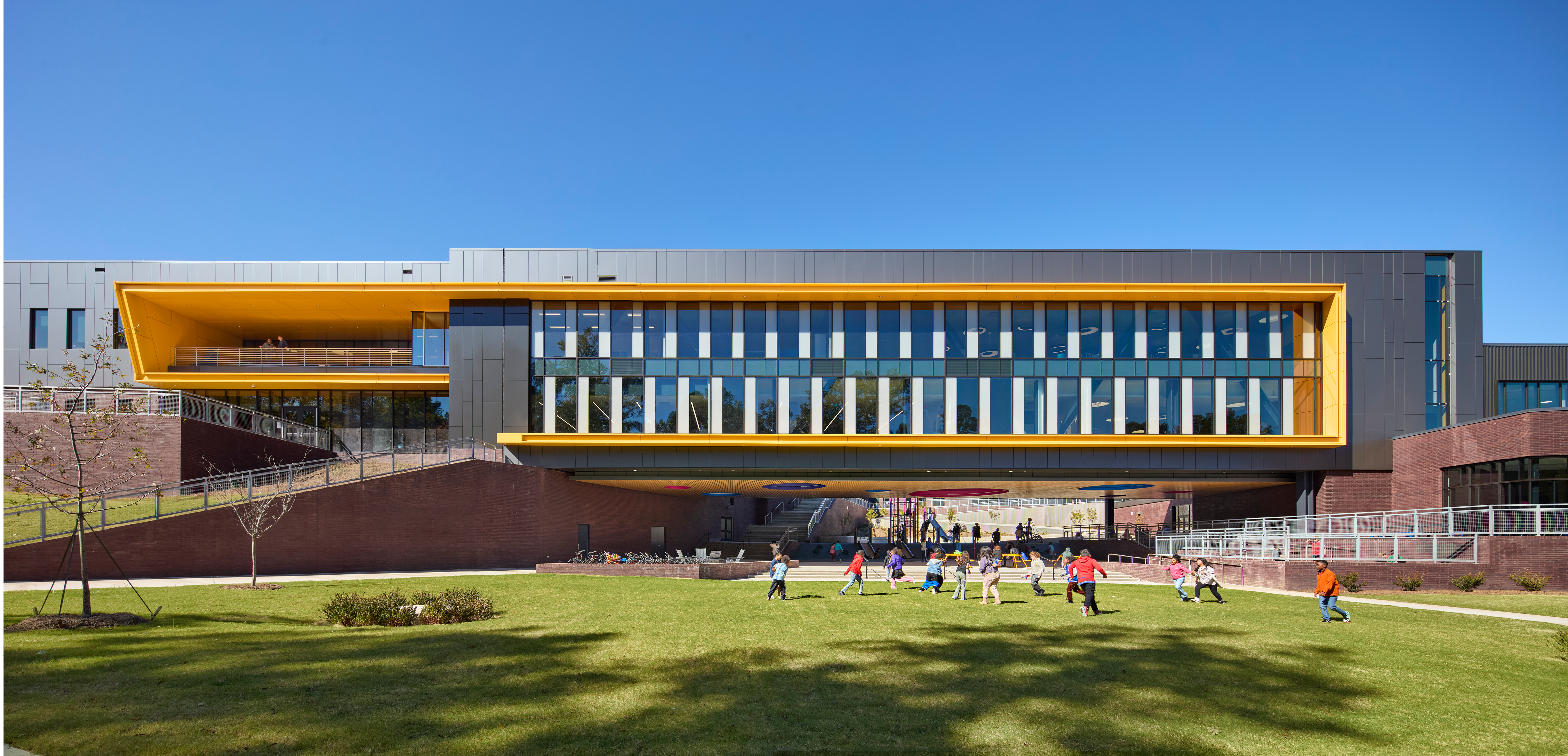
Murray-Massenburg Elementary School
EVOKE Studio | Architecture
Client: Durham Public Schools
schools are rare and opportunity uneven, this building becomes a daily act of optimism—proving that design can nurture curiosity, dignity, and the boundless potential of every child it touches. The mission for this school was to serve as a beacon of excellence in learning and sustainability for Durham County, North Carolina. Raleigh-Durham is one of the fastest growing areas in the United States. From the outset, the design team sought to minimize site disturbance and create a compact footprint that preserved existing trees and wildlife habitats as educational assets for students. Together with a vegetated roof and extensive tree protection, these strategies reduce runoff, mitigate heat island effects common to large developments, and safeguard critical habitats. The school is organized around a central courtyard, optimizing the site’s natural topography while fostering a sense of community among students, teachers, and parents. From the main lobby, students look directly into the courtyard and woods beyond, maintaining a visual and physical connection to nature. The compact plan tailors the 800-student facility to a child-friendly scale, shortens corridors, and encourages learning beyond the classroom. Each corner opens into a learning commons, while a bridge housing shared programs—media center, art, and music—spans the courtyard’s east edge, creating a feeling of learning among the trees. The bridge’s 136-foot truss and other systems are left exposed, turning the building itself into a teaching tool. Environmental graphics extend the learning mission, with classrooms themed around North Carolina ecoregions and common areas highlighting historical figures that inspire exploration and curiosity. Equity and access guided every design decision. The arrival sequence welcomes all students through a shared plaza, ensuring equal treatment for bus and car riders. The COPE program for students with special needs is distributed across two floors, promoting inclusion and avoiding segregation. Inclusive playground equipment further supports accessibility for children of all ages and abilities. Through sustainability, equity, and inclusivity, the school embodies DPS’s core values. DPS also prioritized energy efficiency and wellness. The vegetative roof enhances thermal performance and serves as a teaching landscape about native species. An edible garden introduces lessons on local food systems. High-performance glazing maximizes daylight while reducing energy use, complemented by EV parking, efficient lighting, and water-saving fixtures. The school is on track to become the second public school in the U.S. to achieve WELL Building Certification, underscoring its commitment to human health, sustainability, and student well-being.