
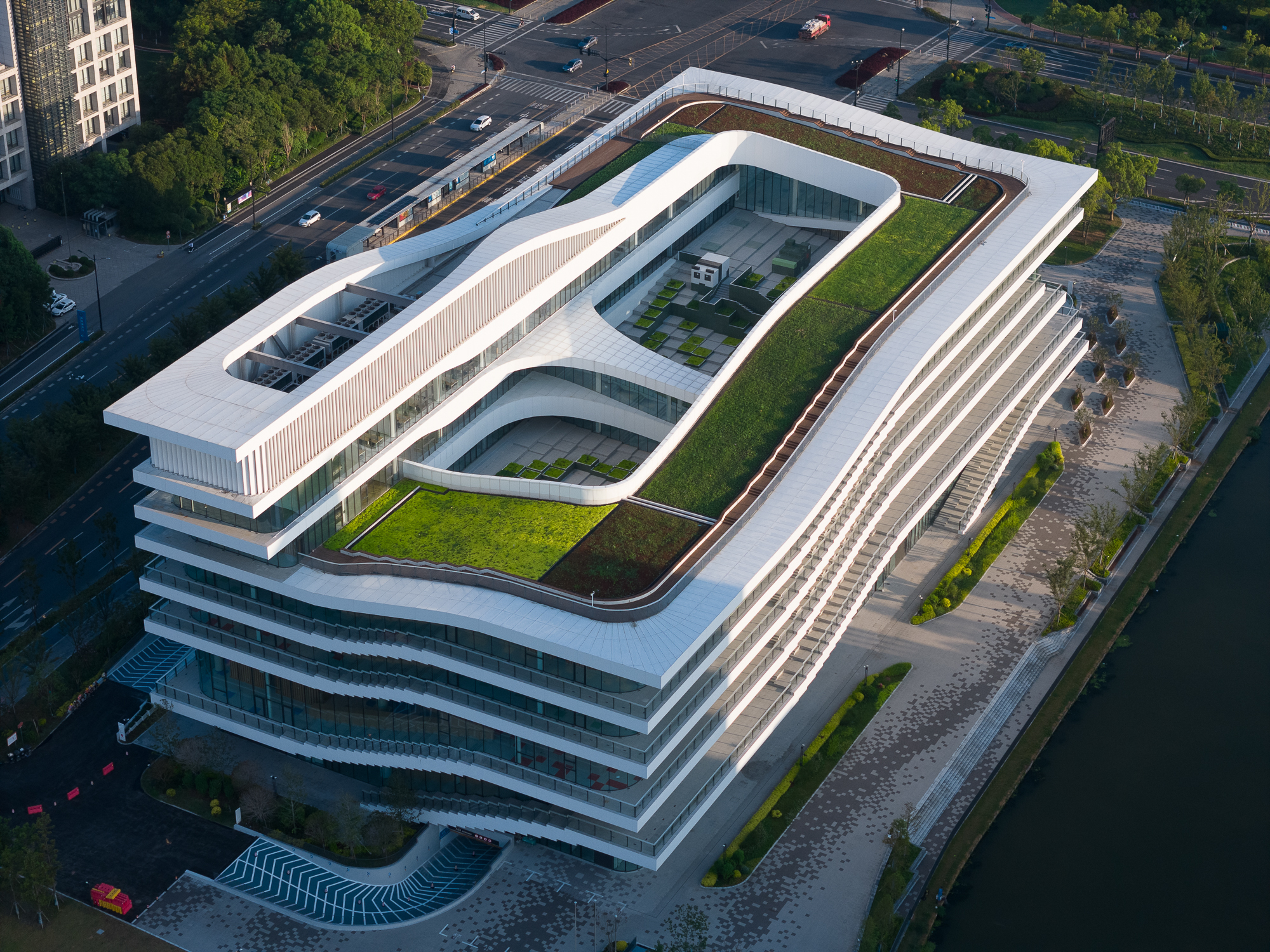
Lingang Youth Activity Center
Arcplus Institute of Shanghai Architectural Design & Research (Co.,Ltd.)
Client: Shanghai Harbor City Development (Group) Co., Ltd
Copyright details: Photo credit: 3000images
The Lin-gang Youth Activity Center is located in Lin-gang Special Area, Pudong New Area, Shanghai. To the north lies a main urban road of the urban area, to the south is a public green space, and to the east is the Chunlian River, enjoying superior transportation and natural resources. The design aims to create a comfortable and interesting exploration space for children rather than just a classroom for weekend training. The architecture features a child-like pixelated design in landscape, interior, and floodlighting designs. The ingenious beautification of the styling design and the concealment of the building's mechanical and electrical facilities enable the entire building to become an exploration paradise with diverse spaces and exquisite details.The main functions of this center include three parts: a science and technology experience hall, a youth activity center, and an exhibition hall; it also contains a 540-seat children's theater. In terms of spatial layout, the internal traffic space is flipped to the outside, and classrooms are arranged around the inner courtyard, making the entire corridor space bright and comfortable. A floor height difference of 2.6m is separately set on the east and west sides of the building, and ramp and staircase spaces are created on the south and north sides of the building, serving as venues for public activities and open classrooms. Starting from the first floor, the entire building spirals upwards through ramps and public staircase spaces, connecting educational spaces with different themes. The indoor space presents a rich and varied flowing state. The ramps and steps connecting the split-level floors increase the diversification and interest of the space, meeting the lively and active disposition of children. The building space integrates with the spiraling ramps, extending from the ground to the roof and breaking the boundaries between floors. In the facade design, the horizontal and vertical circulation systems are adopted to shape spaces and facades, instead of using complex architectural decorations. The corridors and ramps on the facade allow children to walk outdoors in the sunlight, breathe fresh air, gaze at Dishui Lake and the urban landscape, and feel nature. The transparent glass can showcase the vivid state inside the building. Children participating in various activities on the corridors and ramps, together with the building, form a dynamic and rich building facade. The facade is made of white honeycomb aluminum boards and double-layer hollow LOW-E ultra-white glass, ensuring that the facade achieves a contrast of virtuality and reality, saves energy, and is controlled, while maintaining transparency and lightness from a human perspective. The depth and orientation settings of the cantilever slabs on each level are such that the cantilever is smaller on the north side, while on the south and east sides, larger cantilevers are set combined with the viewing platform due to the demand for solar radiation.