
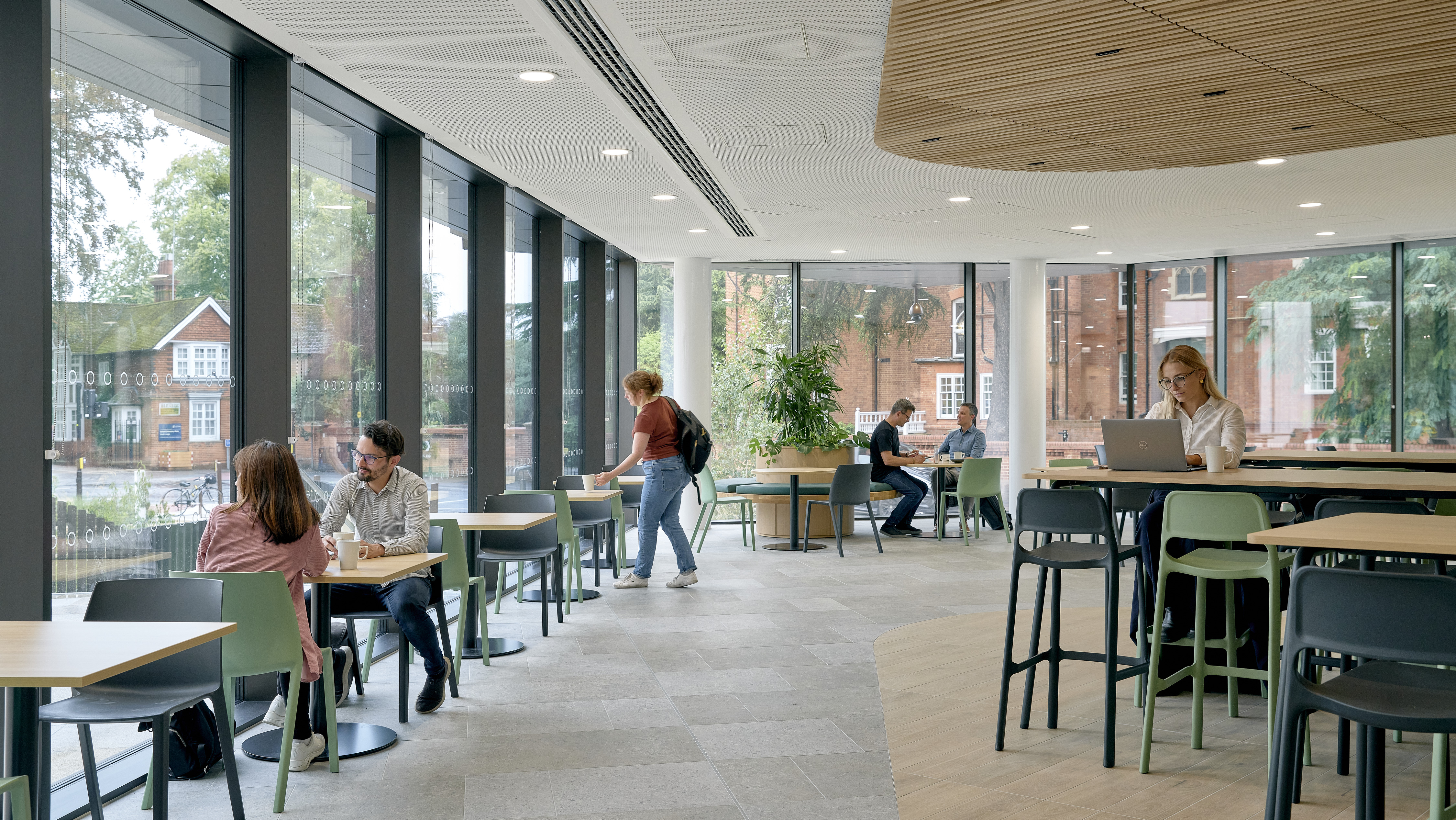
Life and Mind Building, University of Oxford
NBBJ
Client: University of Oxford
Copyright details: Photo credit: Ty Cole
The University of Oxford Life and Mind Building is a transformational new home for the Departments of Biology and Experimental Psychology, uniting two world-leading faculties under one roof for the first time. Designed by NBBJ, the 25,000sqm facility supports teaching and research across the full spectrum of the living world—from molecular biology to cognitive neuroscience—while creating an inspiring environment for more than 2,400 students, researchers and staff.Located at the gateway to Oxford’s Science Area, the building replaces outdated facilities with a state-of-the-art, low-carbon home for interdisciplinary learning. Enabled by a £200 million investment from Legal & General and delivered through Oxford University Development, it represents the University’s largest capital project and one of the most significant new education and research buildings in the UK. A Gateway to Discovery Conceived as a living framework for discovery, the building’s architecture choreographs movement, light, and interaction across a series of interconnected levels. A stepping atrium forms its social and spatial spine, linking laboratories, teaching spaces, and communal zones through a sequence of internal terraces. It crosses the building, leading from arrival via a public plaza up to sweeping views across Oxford’s historic skyline. Occupants are never more than one level away from a green space- whether through biodiverse roof gardens, planted terraces, or the public plaza that anchors the building to the city. This biophilic strategy is integral to the building’s ethos of the ‘life and mind’: it supports mental wellbeing, enhances air quality, and reinforces the building’s ecological identity. At ground level, a new public plaza and stepped amphitheatre creates an inviting entrance to the Science Area. Exhibition zones, lecture theatres and a café place “science on show,” engaging school groups, study participants and visitors in the work of the departments and reinforcing the building’s civic role. Materiality The façade draws on Oxford’s architectural language through reconstituted stone, deep reveals and projecting buttresses that create a contextual yet contemporary character. A distinctive three-dimensional brainwave cast—derived from neural data recorded from researcher Dr Sage Boettcher—translates a two-second moment of cognition into architectural form, symbolising the connection between scientific insight and creative expression. Sustainability Designed to Passivhaus principles and achieving an EPC A rating, the building sets a new benchmark for sustainable research facilities. A highly insulated façade, air-source heat pumps, rooftop PVs and adaptive ventilation contribute to a projected 40% reduction in carbon emissions beyond Part L. Offsite fabrication via Design for Manufacture and Assembly (DfMA) reduced waste and improved quality, while more than 550sqm of green roofs, wildlife habitats and pollinator planting enhance biodiversity and extend the character of University Parks into the site. Flexibility and Efficiency Generous floor-to-floor heights enable research and teaching spaces to evolve, while shared facilities and varied work settings increase operational efficiency. The building uses 21% less space while accommodating 23% more occupants than the previous facility. The result is a landmark educational building that unites science, learning and community in a sustainable, future-ready environment—one that sets a new standard for university research facilities in the UK and beyond.