
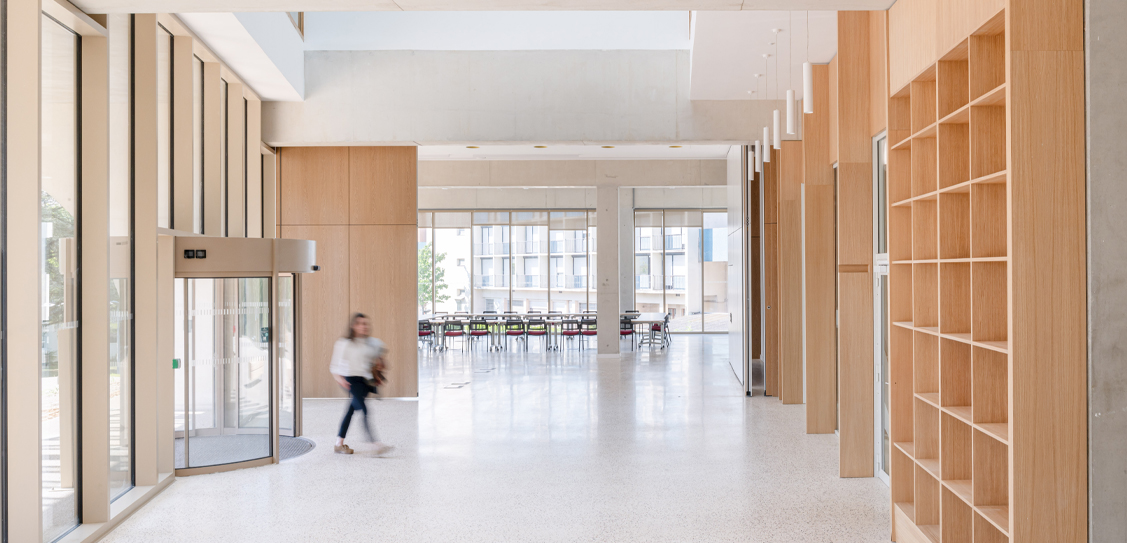
Le Bâtiment de Recherche Biomédicale (Brb) de la Faculté de Santé
Nickl & Partner Architekten AG
Client: Université Paris-Est-Créteil (UPEC)
Copyright details: Photo credit: Christophe Caudroy
The Bâtiment de Recherche Biomédicale (BRB) at Université Paris-Est Créteil (UPEC) is a 5,765 m² research and teaching facility embedded within the hybrid Henri-Mondor campus, linking academic innovation with clinical practice. Designed by Nickl & Partner France, the BRB embodies a new paradigm of biomedical research: transparent, communicative, and socially engaged.The building’s trapezoidal form breaks from the campus’s linear block layout, asserting its autonomy while maintaining strong connections to the Faculty of Health Sciences and the Henri-Mondor University Hospital through multi-level architectural bridges. A central, fully glazed circulation axis organizes offices to the south and laboratories to the north, while a multi-story atrium draws daylight deep into the interior, supports intuitive wayfinding, and encourages informal interactions among approximately 170 researchers. Generous ground-floor glazing and an open research workshop make scientific work visible to the public, reinforcing the BRB’s commitment to transparency. Organically shaped columns echo natural growth patterns, translating life sciences into architectural language. Specialized facilities include L1–L3 laboratories, an animal facility, the PolluRisk pilot hall, seminar spaces, and collaborative platforms. A therapeutic herb garden by DGJ Paysages provides a contemplative outdoor retreat, extending the narrative of health and regeneration into the public realm. The BRB hosts six visionary research programs spanning bioengineering, vaccine development, aging, environmental health, multidisciplinary education, and sustainable innovation. These initiatives exemplify translational research that actively engages with societal, ecological, and health-policy challenges. Open laboratory clusters, shared platforms, and flexible spatial planning foster collaboration and adaptability, ensuring the building’s long-term relevance. Architecturally, the BRB communicates clarity and functional honesty. Materials such as exposed concrete, metal, and translucent elements convey robustness and lightness, while minimal detailing emphasizes operational legibility. Sustainability is understood broadly, encompassing ecological performance, structural resilience, and institutional flexibility. Every design decision, from spatial organization to material expression, reflects science as a process of exploration, communication, and public service. By integrating research, teaching, and clinical practice within a socially and institutionally interconnected framework, the BRB transcends the notion of a traditional laboratory building. It is a generative environment where knowledge is produced, shared, and applied—an exemplar of how architecture can support innovation, collaboration, and societal impact in biomedical research.