
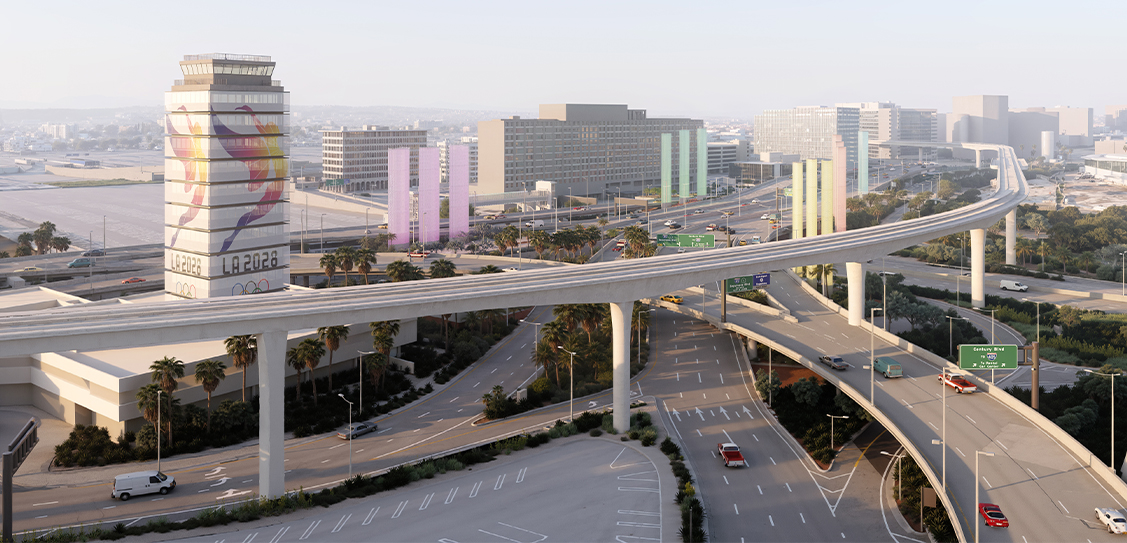
LAX Gateway
Paul Murdoch Architects
Client: Los Angeles World Airports
The existing LAX Central Terminal Area (CTA) was constructed in 1961, at the peak of the Jet Age and a cultural shift towards air travel. Over the next several decades, passenger traffic dramatically increased at LAX leading to explosive growth of the airport. In 2000, the city created an iconic gateway to LAX and Los Angeles, defined by a 32-feet tall ‘LAX’ monument sign, and a circle of fifteen 100-feet tall, illuminated pylons that frame the circulation roads to and from LAX and that have the capacity to program a kinetic light installation that expresses the diversity and creativity of Los Angeles. Since then, a new elevated automated people mover and planned new roadway project will displace most of the gateway features. The new LAX Gateway project reimagines one of Los Angeles’ most iconic civic landmarks with a composition that recalls the gateway’s landmark status and success while redefining the arrival and departure experience for the 21st-century traveler. The new gateway will repurpose the Airport Traffic Control Tower, reinterpret the fifteen illuminated light pylons, and reuse and reposition the monumental “LAX” sign that together define the city’s primary gateway. The design celebrates both heritage and innovation. The historic 1961 Airport Traffic Control Tower, originally the airport’s primary gateway landmark, is reimagined as the central landmark within the new gateway ensemble—its vertical form transformed into a digital media tower with a veil of programmable façade screens that honors its mid-century modern character while serving as a dynamic platform for public art and cultural expression. Fifteen new “wing-form” light pylons, organized in sculptural groupings along and between the roads, evoke the aerodynamics of flight and the fluid geometry of the reconfigured roadways, animated by LED light sequences choreographed with the tower that will now be part of the composition. The relocated “LAX” monument sign anchors the composition, completing a cohesive and future-forward gateway—an illuminated expression of Los Angeles’ identity as a global crossroads of art, architecture, and innovation.