Kaiser Borsari Hall
Perkins&Will
Client: Western Washington University
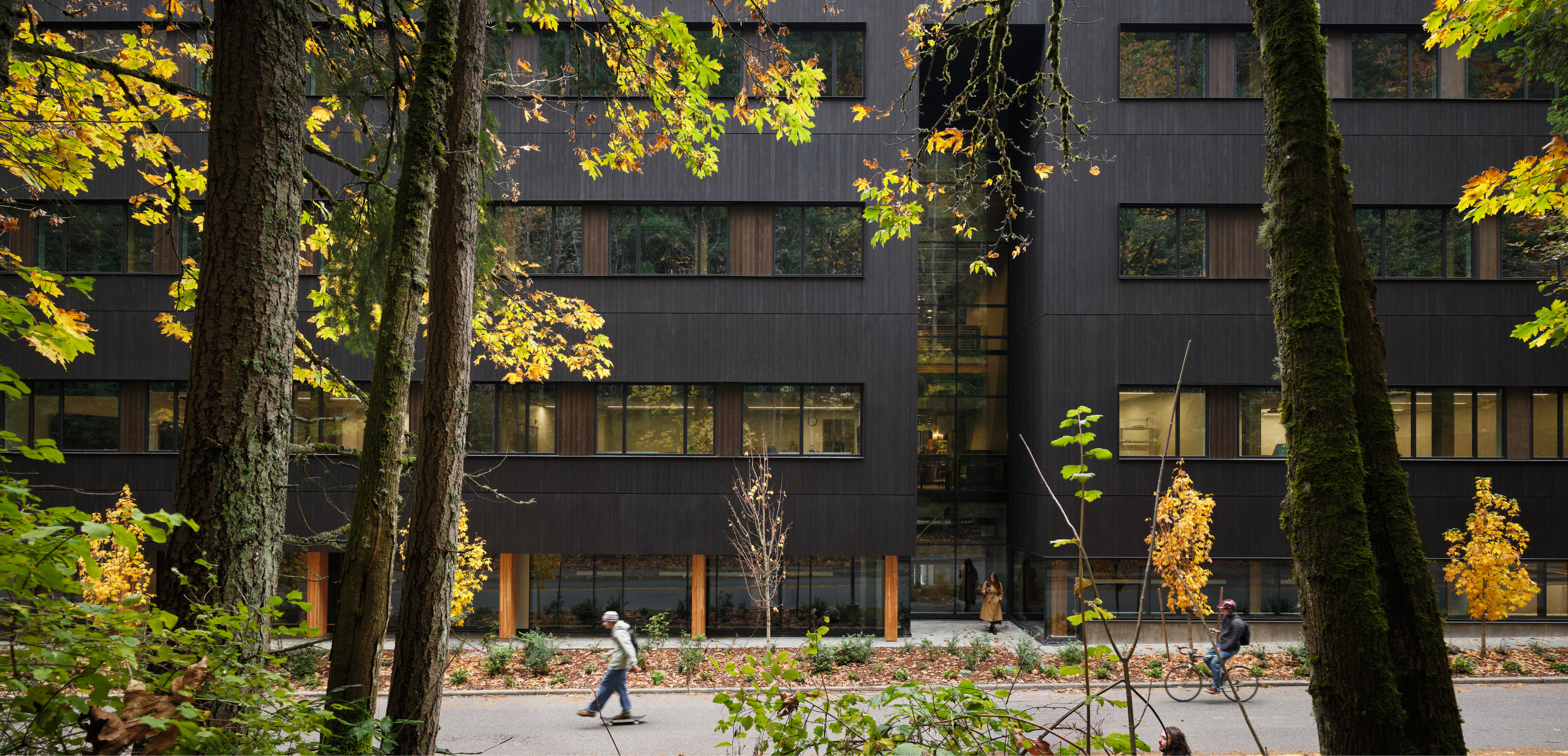
Positioned between the main campus and the native forest arboretum, the building boasts an optimized mass timber structure with a visually striking contrast between warm wood tones inside and charred wood siding outside. Notable features, such as the multicultural lounge, glass-clad stairs with campus views, and biophilic design elements, enhance the overall functionality and aesthetic appeal. Acting as a bridge between industry and education, the facility addresses the needs of Washington State industries. It serves as a collaborative hub fostering innovation and connection among industry experts, faculty, and students, promoting diversity and inclusion within the campus community. Biophilic Approach Transforming a former parking lot into an eco-friendly haven, the site is surrounded by native and climate-adaptive vegetation. Its proximity to Sehome Hill Arboretum enables the integration of diverse plant species, fostering a habitat bridge from the Arboretum to the core campus. Conceived as a simple mass timber structure, the design plays on contrasting wood finishes. The warm and intimate interior structure is poised against dark shou sugi ban exterior cladding, an ancient Japanese technique of burning boards for durability and resiliency. Horizontal windows punctuated by panels of natural finish wood provide views and daylight for the classrooms and offices on every floor. On the ground floor, an airy lobby with central stairs draw students up through the building, while glass walls allow sweeping views of the campus, strengthening the connection to nature. Zero This is the first higher education STEM building to pursue both Zero Carbon and Zero Energy Certifications through the International Living Future Institute (ILFI). The building serves as a “living laboratory,” integrating sustainable strategies that support student learning in Electrical Engineering, Computer Science and the Institute for Energy Studies. It functions as an educational tool, showcasing innovative materials and energy technologies which include infrastructure for advanced battery technology to provide on-site energy storage. Strategies and Performance As the first fully electrified building on campus detached from the steam plant, the building achieves an 87% reduction in embodied carbon and eliminates operational carbon. Over 75% of the roof is covered with photovoltaic panels designed to generate 30-50% of the building’s energy needs, with the remaining energy offset through the Puget Sound Energy Green Power program. Water conservation is supported through a 78% reduction in outdoor water use and a 24% reduction in indoor water use. Passive design strategies include exterior shading, efficient glazing, and high-performance assemblies, resulting in an 85% reduction in Energy Use Intensity (EUI) compared to similar laboratory buildings.