
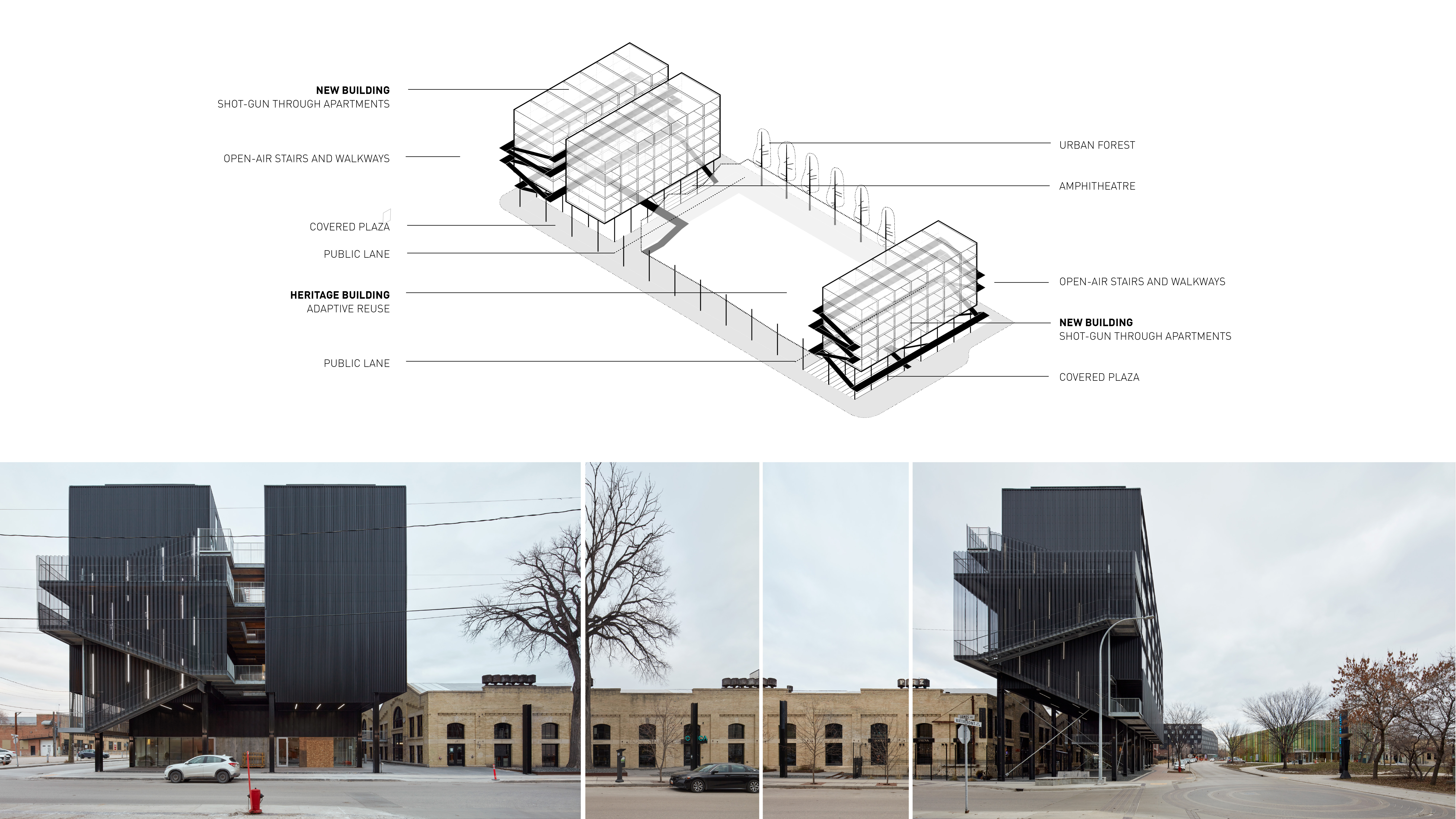
James Avenue Pumping Station
Client: Alston Properties
Copyright details: Photo credit: James Brittain
Slated for demolition after failed attempts to revive Winnipeg’s historic James Avenue Pumping Station, 5468796 developed a financial pro-forma and presented the business case to an existing client, connecting them with the City as an owner and eventually leading to its successful preservation through private investment. The approach treats the pumphouse as a “found object,” preserving all original equipment and working within the existing structural properties while integrating the building into the evolving Waterfront community. Two design interventions made the project viable: repurposing the capacity of original gantry crane rail to suspend a ‘floating floor’ above the equipment below; and the proposal to build a residential block on the 40-foot [13-meter] sliver between the historic building and Waterfront Drive. Unlocking these potentials made the project financially feasible, meaningfully contributing to a historic area in Winnipeg.This adaptive reuse project preserves the space’s utilitarian beauty and gives the building a viable future. In contrast to previous revitalization attempts, the pumping equipment remains unobstructed. The new flexible office floor plate is suspended from the original gantry cranes, creating views into the warehouse through floor-to-ceiling glazing Skylights draw natural light deep into the space, highlighting the equipment in its untouched state. All ground-level entries pass through these layers of history before reaching any new construction, letting the “found object” shape the visitor experience. Materially, the office retains the site’s industrial character, using steel studs and glass stiffening bars to halve glazing thickness and enable faster, more affordable installation. The residential blocks sit 20 feet [6 meters] from the pumphouse, creating new pedestrian “streets” that respect the historic envelope, reinforce human scale, and expand commercial frontages. The interstitial corridors emphasize connections between old and new, with barrier-free paths, outdoor plazas and amphitheatres, and a footbridge linking the west residential block to the heritage building. The weaving nature of these passageways are an extension of the winding streets that define the Exchange District National Historic Site. Articulated connections foster community integration, celebrating the latent vitality of this abandoned infrastructural project. The mid-rise residential buildings mirror the industrial character of the site. They are composed of dual-aspect shotgun apartments and use 100-year-old Nail Laminated Timber [NLT] technology as the floor + ceiling structure, taking precedent from warehouse construction throughout the Exchange District. The project rethinks multi-family efficiency standards, turning the apartment typology inside out. Open-air egress transforms standard interior corridors into exterior passageways that wrap the new and existing buildings, extending the suites, encouraging neighbourly interaction and shared ownership. Open-air stairwells frame views to the city, river, and park. A “skip-stop” layout increases efficiency, reduces corridor area, and allows through-suites with cross-ventilation and strong natural light.