
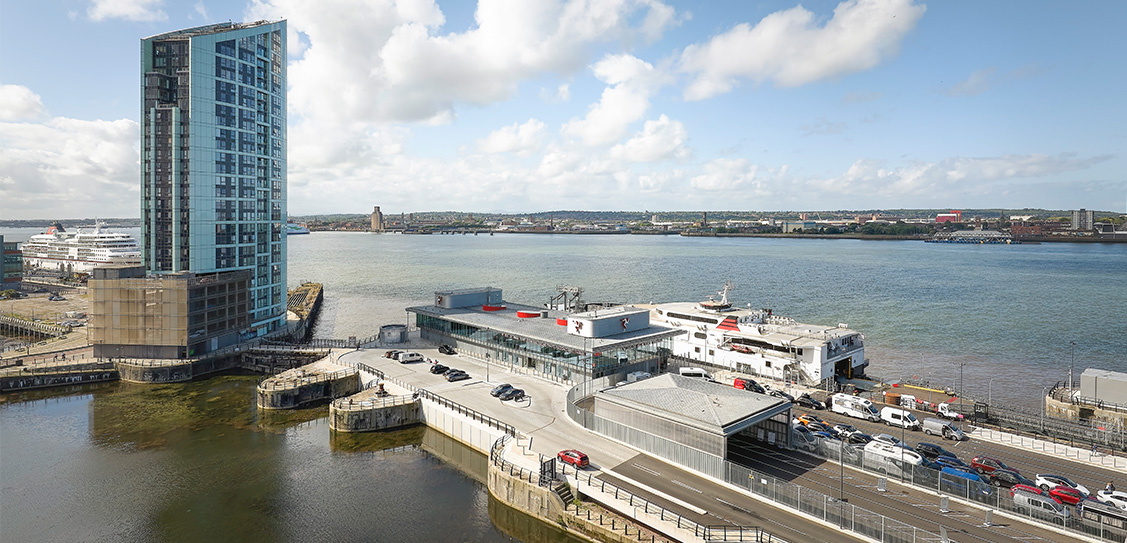
Isle of Man Ferry Terminal
The Manser Practice
Client: The Isle of Man Government (Department of Infrastructure)
The terminal has been designed to sit low and horizontal in its historic context, and has been clad in light, reflective materials to contrast its surroundings. Its main departure lounge is located at first floor and is fully-glazed to provide passengers with panoramic views of the city, the River Mersey, and the adjacent historic docks. Three large rooflights help illuminate the three key internal spaces of security, café and seating areas, and each incorporate the Isle of Man’s distinctive triskelion motif. Below the departure lounge is a ground floor level containing the staff and baggage handling facilities, all clad in natural zinc. This is a nod to the Isle of Man’s historic zinc mining industry, as well as being a robust and hard-wearing material suitable for its waterfront setting. The building’s modest scale and simple form disguise quite a complex series of operational and security requirements. For instance, care was taken to separate staff, baggage, vehicles and foot passengers on and off the vessel to avoid congestion and bottle-necks. Foot passenger experience is prioritised, with their journey through the building organised around the perimeter to ensure they are always in visual contact with the ferry, making their experience of the terminal simple and intuitive. Passive design principles help minimise running costs and keep the building as low-maintenance as possible. Most of the building is naturally-ventilated, and heating is provided by air source heat pumps. The large oversailing roof helps reduce solar gain as well as sheltering passengers and baggage handlers from the elements. The historic site presented a number of challenges too. Liverpool’s Prince’s Half Tide Dock dates from the mid-1800s and was interspersed with a maze of chambers, culverts, and is almost completely surrounded by water. This meant a considerable amount of marine works were required, and a series of archaeological artefacts were uncovered as ground works progressed. Many of these historic features, such as capstans, bollards and mooring posts, were incorporated into the landscape design. These add interest to the public realm, which also provides a new footbridge between Princes Dock and Central Docks. The completed building is an efficient, secure and purpose-built terminal that has given a new lease of life to a long inaccessible area of Liverpool’s historic waterfront.