
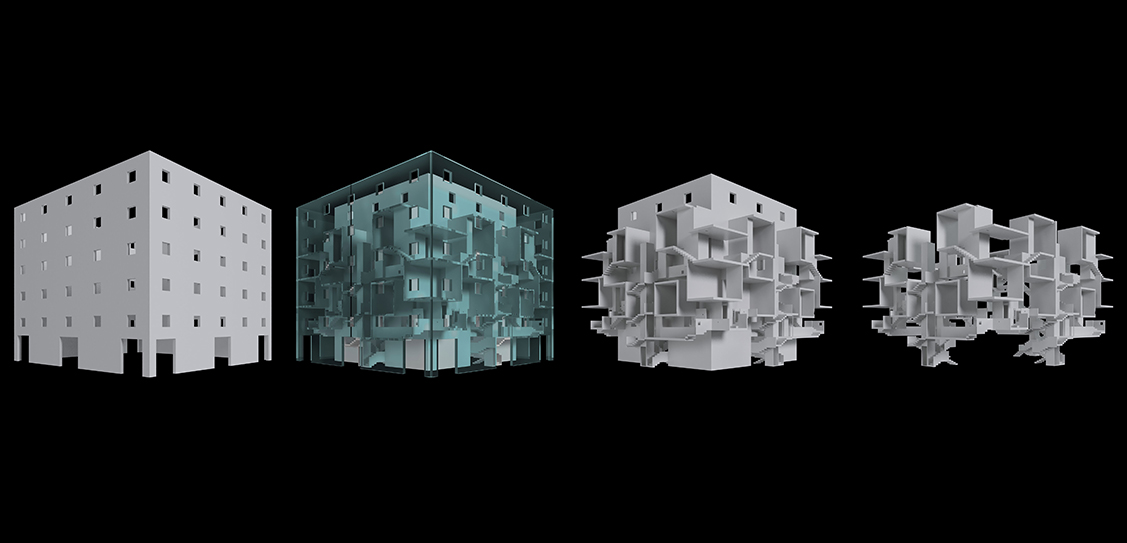
Interstice House – In-Between space
Amin Mohseni Architectural Studio
Client: Amin Mohseni
The project departs from ideas of spatial transparency, seamless continuity, and efficiency that dominate modernist housing. Instead, it embraces fragmentation, layering, and ambiguity. Circulation is bodily and sectional—inhabitants experience space through thresholds, transitions, and vertical movement. Architecture happens not on surfaces, but in the void between structural boundaries. At the heart of the project lies an unclaimed courtyard: a void that resists program and ownership. It acts as a spatial pause—neither decorative nor functional—interrupting density with openness and inviting reflection. The façade, too, follows this critical stance: detached from structural logic, it operates as a permeable membrane, with calibrated perforations that mediate light, air, and weather. Natural light becomes an agent of time, animating the interior spaces with changing atmospheres throughout the day. Materially, the house relies entirely on cast-in-place reinforced concrete. Walls, floors, and ceilings remain exposed, expressing structure and thermal mass while minimizing surface finishes. This rawness creates an aesthetic of honesty and restraint, aligning with the project’s conceptual clarity and material economy. Concrete here is not merely a construction system—it becomes a medium for space, light, and duration. More than a design, The In-Between House is a critique. It questions how much space is enough, and how meaningful spatial experience can arise from limits, not excess. It proposes micro-living as an opportunity rather than a compromise—inviting slower, more aware forms of dwelling. By resisting spectacle and formal expression, the project positions itself as “slow architecture”: unfolding over time, through use, atmosphere, and lived experience. Ultimately, the project does not aim to resolve domestic or urban crises. Instead, it frames essential architectural questions: How can space shape thought? How can housing be reimagined as cultural infrastructure? And how can architecture offer depth in an age of acceleration and fragmentation?