
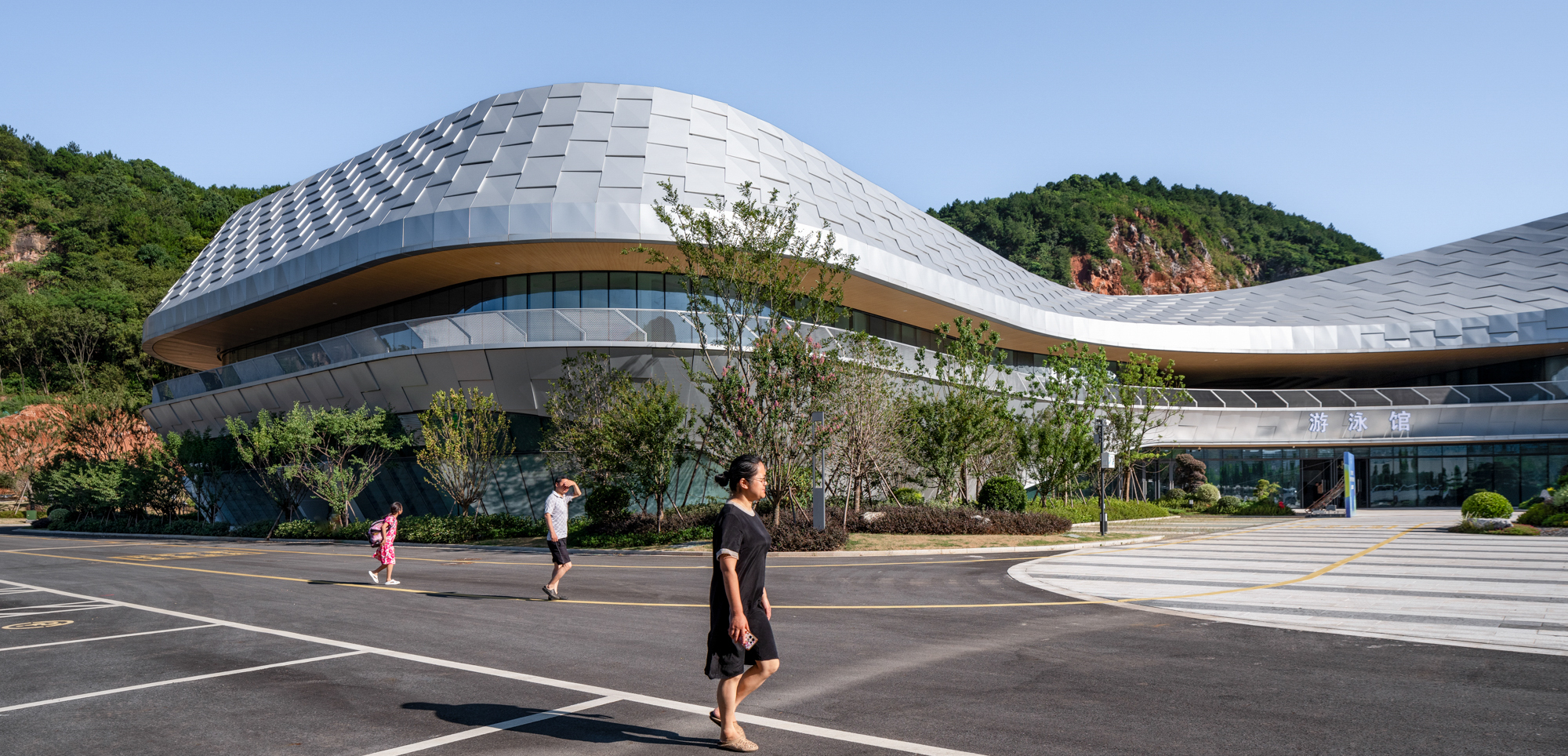
Hushan Sports Park Swimming Center
LYCS Architecture
Client: Jiangshan Sports Bureau
Copyright details: Photo credit: ©Shan-Jian images
The Hushan Sports Park Swimming Center in Jiangshan was designed by LYCS Architecture, which led the project's integrated architectural and interior design. Located in the heart of Hushan Sports Park, the facility is the first professional-grade swimming venue in the city to meet Class B national competition standards. With a total floor area of 14,244 square meters, the center includes a standard competition pool and a training pool, serving as a multifunctional venue that accommodates both professional events and daily public use.Upon completion, the project made Jiangshan the first county-level city in Quzhou to fulfill the "one stadium, two arenas" public sports infrastructure system. The new swimming center not only significantly enhances the city's overall athletic facilities but also fills a long-standing gap in public swimming amenities. It provides a versatile space capable of hosting competitive events while serving the everyday needs of the local community. Located at the foot of Hushan and facing Jiangshan Port, the swimming center is part of the "one stadium, two arenas" public sports system, forming a city-level athletic hub. Drawing inspiration from Jiangshan's unique landscape and cultural identity, the design adopts the motif of "mountain and water." Its undulating form responds to the terrain, while fluid lines evoke the motion of rivers—creating a dynamic, contemporary venue in dialogue with both nature and urban life. The center includes two standard pools, both 2 meters deep: a 50×25m eight-lane competition pool and a 50×17m six-lane training pool, supporting both competitions and daily use. A dual-ground-level circulation strategy separates athlete and spectator access under normal conditions. During events, second-floor stands, dedicated corridors, and functional zones enable efficient separation of athletes, media, VIPs, organizers, and the public, optimizing flow and operations. Avoiding symmetrical or enclosed forms, the design employs a folded geometry of horizontal, sloped, and vertical surfaces. The curved roof bridges the east and west halls, creating a semi-open public space as an urban threshold. The main entrance, marked by a spiraling roof and elevated platform, enhances the ceremonial arrival. A "scaly" metal panel system on the facade reflects shifting light, evoking flowing water and terrain, adding depth and motion to the building's skin. The swimming center's facade consists of 2,943 uniquely shaped "scaly" metal panels covering 17,000 sqm. Each panel was individually coded via parametric modeling and custom-fabricated, then installed piece by piece at heights up to 25 meters—demanding precise coordination. The system showcases advanced control over complex geometry and exemplifies a fully integrated digital-to-construction process in contemporary sports architecture. The interior continues the folded logic of the facade, applying modular and pixelated treatments to surfaces and signage. The 48-meter-span roof trusses are fully exposed, emphasizing structural logic and spatial intensity. Colored metal panels, fluorocarbon finishes, and perforated elements define zones through contrast and rhythm, creating a sports environment that is both functionally clear and visually engaging.