Čoarvemátta
Snøhetta
Client: Statsbygg, The Norwegian Governmental Building Agency
Copyright details: Photo credit: Lars Petter Pettersen/Snøhetta
Lead Architect: Bård Vaag Stangnes
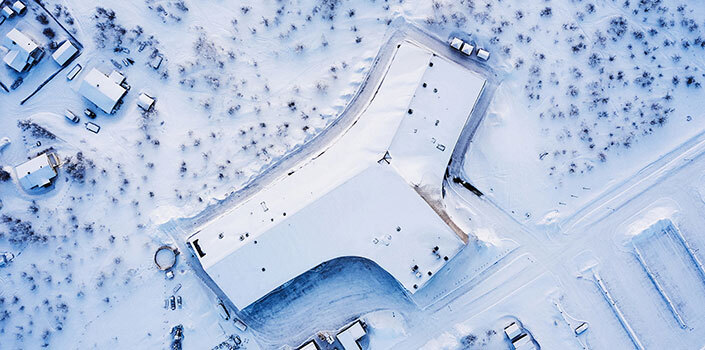
Čoarvemátta is a new shared facility of The Sámi National Theater Beaivváš, and the Sámi High School and Reindeer Herding School, two important cultural institutions of The Sámi settlement area of Sápmi.The name comes from the Sámi words “čoarvi” and “mátta”, meaning “horn” and “root”, which characterize the strongest part of the reindeer antler - often used in duodji, traditional Sami crafts and handicrafts. Čoarvemátta is located in Kautokeino in the middle of Finnmarksvidda, Norway's largest and northernmost plateau. The two-storey building is low in the landscape and has proportions that harmonize with hills and elevations in the surroundings, avoiding angles breaking with the landscape’s natural shapes. As the innermost joint of the reindeer horn symbolizes different qualities and strengths and represents two elements that unite, Coarvematta is unifying for the theatre and the school. The co-location means that the institutions can take advantage of each other's facilities and jointly operate robust, spacious halls and rooms. This is in line with the Sami ideology of taking care of and utilizing all resources. The new shared space has a branching shape, with a main entrance and vestibule in the center. From here, the building stretches in three different directions – adapting both visually and functionally to the landscape – with a wing for each of the three functions; the theatre, the school, and the faculty. The vestibule is the focal point of the building. The curved lines, the highlight of the roof with skylights like from a reahpen, smoke hole, and the visible load-bearing glulam wooden structure, are inspired by light wooden constructions typical of reindeer-herding Sami areas, such as the lavvu. The façade of the building is made with standing wood cladding in ore pine. The Alta slate on the theatre's gable wall has been reused from the village's old primary school, which has been demolished. Inside the vestibule and corridors, the polished concrete floors mimic the ground outside the building, with elements of locally mined stone, including slate and masi quartzite, in various shades of grey and green. The walls have wooden slats and oiled smooth-edged wood paneling, while all the fixtures are carved in pine and ash veneer. The center of the building, around the foyer, vestibule and theater halls, is painted in warm, red shades. Then the color scheme becomes cooler, and the further away from the hearth you get, the colder the colors become, with bluish tones at each end of the building's wings. The Sami culture has no tradition of cultivating landscapes. Over the entire construction site, soil that has had to be removed has been preserved, the top layer has been temporarily stored, and subsequently returned to all surfaces around the building, so that the seed stocks are intact. Čoarvemátta is a Passive house. The building is 90% self-sufficient in energy to heating and cooling from wells and heat pumps thanks to 40 geowells drilled about 250 meters into the ground.