
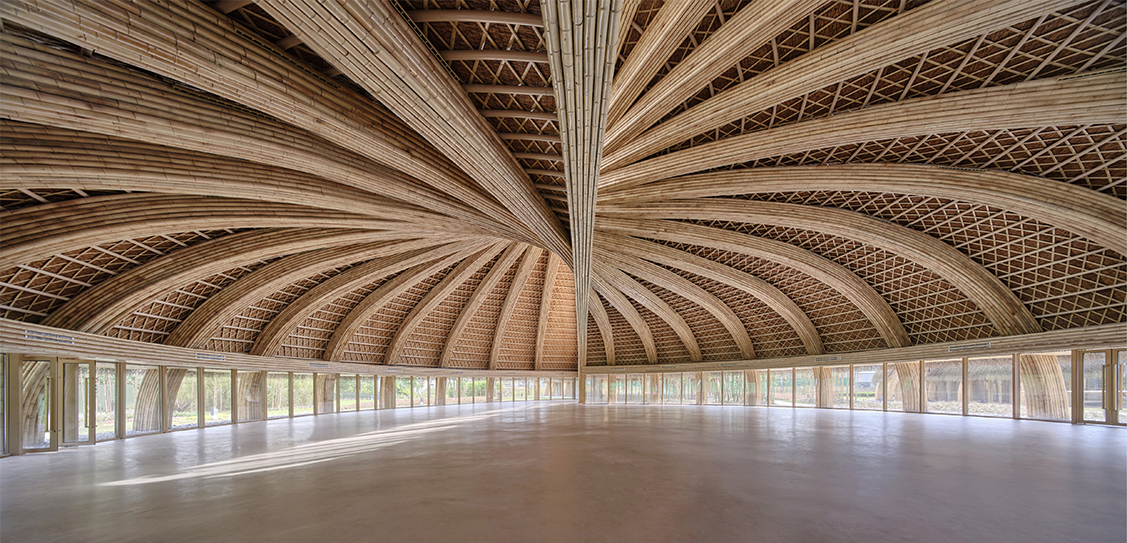
Changning Bamboo Culture Center
TONGJI ARCHITECTURAL DESIGN (Group) Co., Ltd.
Client: Changning County Urban Construction Investment Co., Ltd.
The design takes the efficiency into account to minimize construction time and adopt structural forms that most effectively utilize the characteristics of materials. Bamboo is light and strong, with outstanding toughness, it can absorb seismic shocks in a flexible structure. Therefore, a tensile arch structure is selected to utilize the material efficiently, poetically characterize the strong tenacity of bamboo, and to enable the building to withstand earthquake damage. Respecting the original regional landscape and reproducing the locally “Bamboo Forest Plate” spatial texture, the building volume is split into three single units of different sizes serving as an exhibition hall, a multi-functional hall and a tea room, with a compact layout, hidden in the surrounding bamboo bushes. Design Innovation Structural Composition As an important public center of the town, the building provides a large flexible space that can accommodate local cultural activities. For a more communal scale, we use bundled jointed bamboo to break the limits of the length of single bamboo and achieve a large span and height. The arches are made of selected native bamboos with a diameter of 80mm, with each 22 fixed in a group. After anti-corrosion treatment, they are fixed at the base of concrete, formed by fire baking, and then stacked in turn to form a double helix. With a minimum span of 25.7 meters and a maximum span of 42.7 meters, these arches loop around the building to interact with the interior column-free space. Covered by bamboo sunshade grilles, the two openings of the spiral space provide natural light and ventilation throughout the whole space, ensuring the comfort and energy efficiency of the building. The curtain wall and structure are combined with elastic variable nodes to reduce the extrusion caused by the deformation. The interior equipment is arranged in the invisible area between curtain wall and roof to keep the integrity of the space. The structural system of the building is made of raw bamboo, the roof structure is assisted by gabions, and the surface layer of the bamboo is woven from the branches of the bamboo, making full use of the remaining part of the bamboo material other than the main material. The carbon emission of bamboo building in the whole life cycle is only 2% of the same volume of concrete construction, and can be directly recycled. As a post-disaster reconstruction building, the design is fully based on the seismic performance of the selected materials, which helps to improve the seismic capacity of the building, to control the construction period in four months, and become one of the first public buildings opened after the earthquake. The large interior space is used for activities such as bamboo crafts exhibitions, Lantern Festival fair, and local dance performances.