
Chandigarh University - D6
Charged Voids
Client: Chandigarh University
Copyright details: Photo credit: Javier Calejas
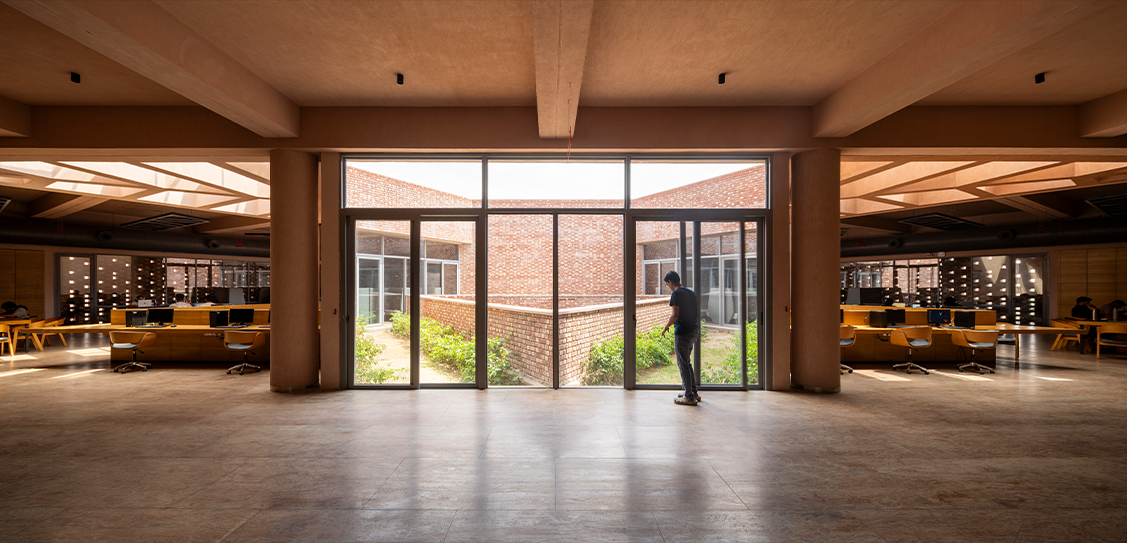
Located within the 23-acre campus of the University Institute of Management Studies at Chandigarh University, this 94,000 sq.ft. multi-utility building caters to over 7,000 students, integrating a cafeteria, library, and guest house within a single built volume. Situated in Gharuan, a peri-urban region near Mohali—a satellite town of Chandigarh—this project draws both contextual and architectural inspiration from its modernist surroundings, with Chandigarh itself being a city envisioned by Le Corbusier.CONTEXT & CONCEPT: Initially conceptualized as three independent structures, the design evolved into a consolidated built form as a result of ever increasing FAR and change in building byelaws midway through the development of campus. The resulting structure is not just an efficient response to the revised brief, but a bold architectural gesture that reimagines student infrastructure through spatial layering and dynamic form. Two rotated triangular prisms interlocked with a cuboid define the building’s distinctive form. These strong geometrical volumes eliminate any singular “front” or “rear” façade, instead orienting themselves toward the central amphitheatre plaza of the academic blocks. This strategic alignment anchors the building within the campus’s pedestrian spine, establishing both prominence and accessibility. The dynamic triangular forms introduce large overhangs and shaded recesses, fostering incidental interaction zones and promoting thermal comfort. The absence of enclosing walls at the ground level further creates an amorphous, open-plan layout that blurs boundaries between inside and outside, reinforcing ideas of community and movement. PROGRAM & PLANNING: The building is vertically zoned by function: •Ground and First Floors: Designed as student commons, these levels accommodate everyday needs—cafeterias, retail spaces, and utility shops. The first floor features a dining hall with a fixed menu that serves approximately 500 students. •Second and Third Floors: A double-height library occupies these levels, accessible via a grand staircase that begins near the primary entrance—an architectural promenade that transforms movement into an experience. •Upper Floors: Reserved for a guest house, these levels host VIP visitors and faculty, with a dedicated reception and separate entry ensuring functional segregation and smooth circulation. Multiple entries and circulation cores ensure that each programmatic component functions independently yet remains integrated within the larger spatial ecosystem. MATERIAL PALETTE: Materiality plays a central role in shaping the building’s identity. The exterior is exposed brick laid in Flemish bond, with perforated jaalis offering filtered light, ventilation, and a connection to regional architectural traditions. Red sandstone flooring and exposed red brick in public zones reinforce a tactile, grounded atmosphere, unifying the various spaces through a warm, earthy palette. A RESPONSIVE, LIVING SPACE: More than a building, the Student Centre is envisioned as a living built form—an architectural organism that responds to its users and environment. By transforming circulation into interaction, function into form, and necessity into opportunity, it stands as a contemporary addition to the academic landscape—rooted in context, driven by utility, and expressive in form.