Buffalo Crossing Paul Albrechtsen Visitor Centre
Stantec Architecture Ltd.
Client: FortWhyte Alive
Lead Architects: Michael Banman and Steph Fehr
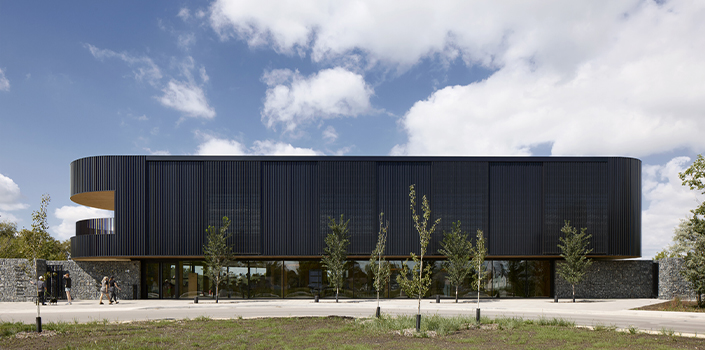
In 1955, employees of the Canada Cement Company came together to establish the FortWhyte Waterfowl Sanctuary. Determined to reintroduce Canada Geese and Mallard Ducks back to the site, they reclaimed the company’s clay and gravel mining pits. Over 65 years later, located on the edge of Winnipeg’s burgeoning southwest, now FortWhyte Alive (FWA), it’s nature campus has grown to 660 acres including Reception and Interpretive Centres, offering public environmental education and recreation programs that promotes awareness and understanding of the natural world and actions leading to sustainable living, and Social Emprise Farm and Wood Shop.Situated on the South shore of Muir Lake, the largest of seven lakes and North of a primary motorway into the City, Buffalo Crossing (BX) will be FWA’s new marquee gateway. BX will provide FWA with a living exhibit of climate resilience and stewardship, reconciliation with Canada’s first peoples, raise the quality of visitor experience, and facilitate expanded programming and revenue capacity for this non-profit. The 18,000 sf two-storey all mass timber Visitor Centre, will facilitate admission to the site, including part of Canada’s Great Trail, and will consist of a nature gift shop, café, lobby, all-inclusive gender neutral washrooms, learning space, pre-function and indigenous spaces, prep kitchen, and event spaces. Special consideration was given to the extreme climate in south central Canada with conditions ranging from -40° C and 0% relative humidity to +40° C and 100% relative humidity and future predicted climate data to inform the design of BX targeting CaGBC’s Zero Carbon Building Design Standard and Passive House Certification. Set back on the site, BX is first seen through wispy aspens, perched on and between two sections of granite gabion wall each paired with and offset from separate gabion walls partially concealing the ‘natural garden’ within, while allowing visitors to access the site between, and see through the visitor centre to what they are about to experience. Open, transparent, and welcoming the visitor centre is designed to attract new visitors and members with a building that is memorable, connected with its naturalized setting. The building form is triangular in plan with one ‘point’ oriented north, limiting a façade with minimal solar exposure, opening up a northwest façade to remarkable views across the Lake, while the prominently south façade directly faces the motorway providing a strong physical presence. The plan is bisected by a service spine separating Pre-function spaces along the south facing façade and Event spaces overlooking the lake. The upper volume extends over the lower volume to provide shade, stepping up at the event space to provide a grander volume. The corners are rounded, softening its presence within the aspen forest. Two ends of the upper volume are carved out forming balconies facing north and west. Interior features which refer to indigenous culture were carefully curated. Including language, interpretive elements, and the Star Blanket pattern embedded in the second floor gathering space celebrate indigenous culture, history, and knowledge. The bison (buffalo) makes a prominent appearance in the Running Buffalo Donor Wall.