Ballpark NEXT Community Design Plan
Perkins&Will
Client: Salt Lake City Community Reinvestment Agency
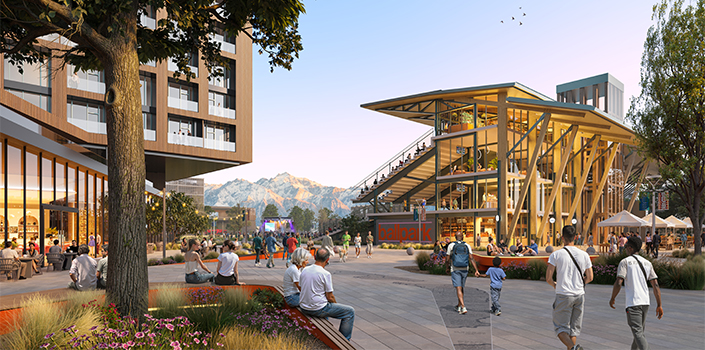
This Plan charts a new future for the site, transforming it into a health-forward, mixed-use destination grounded in the Social Determinants of Health, upending the offerings of an otherwise under-resourced, underinvested, and low-income Ballpark neighborhood. Rooted in both memory and renewal, the plan adaptively reuses a portion of the Ballpark as a year-round entertainment anchor. It also boldly proposes to unearth three of Salt Lake City’s seven historic creeks that are currently culverted along the site. The result is a values-focused master plan that informs long-term public and private investment to enhance neighborhood pride and dignity. The project’s framework grew out of the city’s deep, sustained public engagement and direct collaboration with neighborhood stakeholders. Salt Lake City residents helped shape a shared vision that honors the site’s past while embracing what’s next for the Ballpark neighborhood. The adaptive reuse strategy transforms the southwestern wing of the stadium structure into a flexible venue that supports community, cultural, sports, and entertainment programming at a scale currently underrepresented in Salt Lake City. Rather than erasing the historic fabric of the ballpark, this approach preserves meaningful elements — such as the bleachers, the concourse, and home plate — that embody collective memory and neighborhood pride while activating them for new, everyday uses that bring people together. Surrounding public spaces are envisioned as welcoming places that strengthen social connectivity and civic life. A proposed festival street along 1300 South and West Temple will host markets, arts, performance, and cultural events, making room for local expression and informal community interaction. The Creek Park daylights three of Salt Lake City’s creeks, introducing an ecologically responsive public park in a neighborhood deprived of meaningful access to nature. The plan also improves walkability, introduces plaza spaces, and enhances connections to existing transit, neighborhood services, and amenities. The Ballpark NEXT plan advances inclusive mixed-use development by introducing attainable homeownership models, a new public library, a fresh food grocery store, a health clinic, and dedicated ground-floor space for local small businesses—ensuring a more inclusive urban fabric where existing and future residents can live, work, and thrive close to essential amenities. The transformation of the Ballpark site offers a framework for long-term investment in community identity, cultural expression, social cohesion, and neighborhood resilience. By preserving meaningful history while embracing innovation, the Ballpark NEXT Community Design Plan creates a thriving urban destination that reflects what Ballpark residents value today while uplifting the community’s future.