
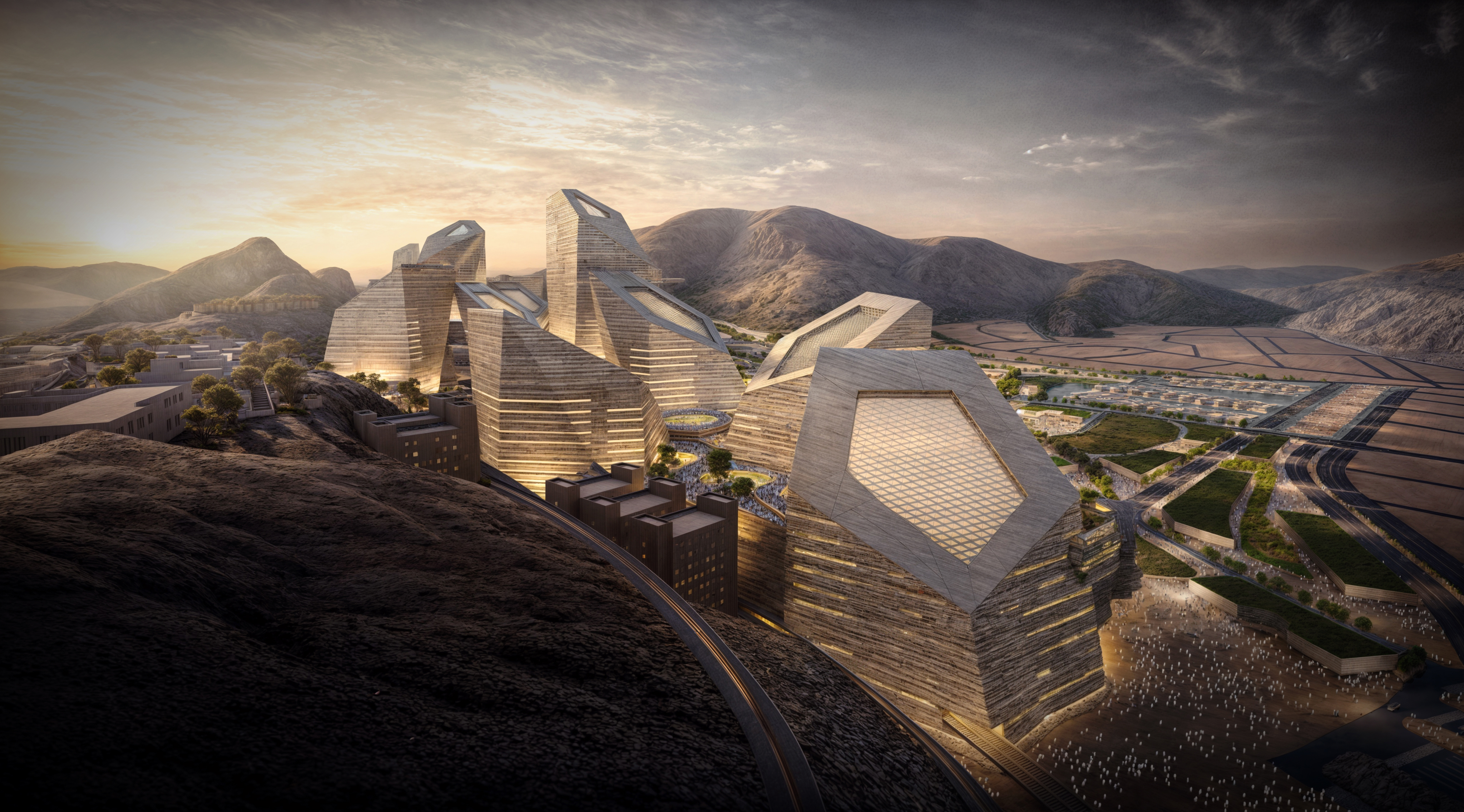
Al Rabita
HKS Architects
Client: Kidana
Copyright details: Photo credit: Rendering by CGXCG
The Al Rabita project in Mina, Makkah, is a visionary undertaking that reimagines a sacred Islamic site into a transformative year-round spiritual and communal destination. Rooted in the values of Saudi Vision 2030 and guided by the teachings of the Quran and Sunna, the project aspires to create a place where spirituality, tradition, and innovation converge to enhance the pilgrimage experience while preserving the sanctity of Mina.Designed to serve up to 750,000 pilgrims during Hajj and support local life throughout the year, Al Rabita integrates architecture, landscape, and mobility into a seamless whole. The design honors the historical and geographical context of Mina Valley—its mountains, wadis, and desert landscape—by adopting forms and materials that echo the land’s natural beauty and cultural resonance. Architectural elements are drawn from the textures of dunes and the symbolism of the Five Pillars of Islam, creating a built environment that feels timeless yet forward-looking. At the heart of Al Rabita is the principle of flow—spiritual, physical, and emotional. The site’s circulation is carefully aligned with the natural tributaries of the valley, guiding pilgrims intuitively through a sacred journey that fosters connection, reflection, and unity. Districts are organized around key themes—light, earth, and water—each designed as ecosystems supporting diverse activities, from worship to rest to celebration. The project is a model of sustainable design. It achieves net-positive energy performance through renewable systems such as solar PV, wind turbines, and biogas co-generation. Water management employs a closed-loop system that recycles wastewater and captures stormwater. Advanced mobility systems—including underground trains, micromobility paths, and vertiports for drone transport—reduce congestion and environmental impact, while preparing the site for future innovation. Socially and culturally, Al Rabita is deeply inclusive. Spaces are designed to support spiritual experiences for people from diverse backgrounds, promoting equity, comfort, and access at every scale. Traditional design elements like shaded alleys, courtyards, and wind towers are reinterpreted to foster gathering, prayer, and contemplation. The project provides both communal and intimate moments, encouraging spiritual engagement and collective memory. Economically, the project extends beyond seasonal pilgrimage use. By transforming Mina into a year-round hub for hospitality, culture, and education, Al Rabita supports local artisans, businesses, and service providers—generating long-term economic sustainability and resilience. The flexible design allows the site to adapt to evolving needs while remaining grounded in its sacred mission. Al Rabita is not merely a place—it is a journey. A place where ancient rituals are honored through contemporary design, where nature and architecture are in dialogue, and where faith, technology, and culture align to create a sanctuary of belonging, purpose, and beauty. It stands as a global model of spiritually driven, environmentally responsible urban design—deeply rooted in place, yet universally resonant.