40 Thorndike
Elkus Manfredi Architects
Client: Leggat McCall Properties & Granite Properties
Lead Architects: David Manfredi FAIA, LEED AP and Maria Schroeder AIA, LEED AP
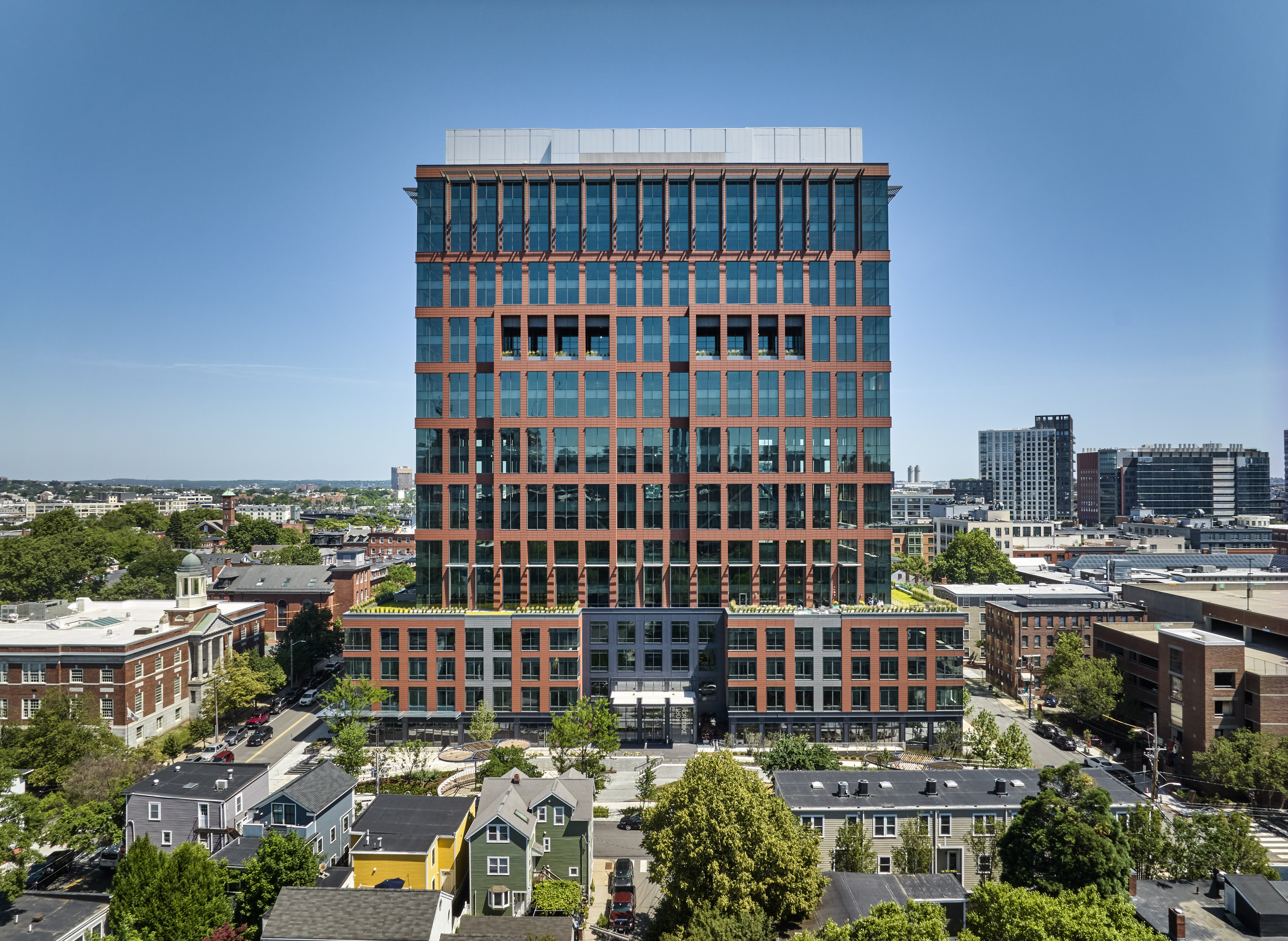
Reinvented as a mixed-use office, residential, and retail destination certified LEED Gold with WELL Core v.2 Gold certification pending, 40 Thorndike represents the rebirth of a painfully out-of-place structure transformed by over a decade of architectural planning, design, and construction into a good neighbor contributing to the community for the benefit of all.
In the late 1960s, the Commonwealth of Massachusetts had taken an East Cambridge site – donated on the condition that it forever be used for beneficial purposes – by eminent domain and constructed the 22-story Edward J. Sullivan Courthouse housing 16 courtrooms and four levels of incarceration facilities. Designed in the Brutalist style, focused on security, and overwhelming its neighborhood of two- and three-story residences and small-scale brick buildings, the Courthouse opened in 1971 but never fit into its neighborhood, which had had no input into the design of the Courthouse. In 2008 the building was closed due to health concerns and in 2010 was sold in a competitive process that ensured neighborhood input. Teaming with Elkus Manfredi Architects for programming, architecture, and community engagement for the adaptive reuse of the building, the partnership of Leggat McCall Properties, Granite Properties, and CBRE Investment Management won the competition and purchased the property. The redesign was driven by sustainability and the health of the building’s occupants and neighborhood, and creates 39,205 square meters of Class-A office space, 48 new affordable housing units totaling 3,380 square meters, a 1,300-square-meter neighborhood park, 1,059 square meters of glass-fronted ground-floor retail, childcare, and a 180-person tenant and community multipurpose space.
Major decisions made with the community include: Addition of 48 affordable apartment units Removal of the building’s top two floors, breaking up the mass of the podium façade and building footprint, and placing windows all around to open the lobby to its surroundings Recladding of the entire façade with a panelized system of glass curtain wall and terra cotta materials that integrate with surrounding buildings and provide more energy efficiency Repurposing the sally port into a 24/7 publicly-accessible green park, a change that established a public realm and transforms the landscape of the block Major sustainable elements include: Reusing 92% of the existing structure prevented the release of ~9,500 metric tons of carbon dioxide (CO2) compared to new construction. To safely remove the top two floors and the entire building envelope plus demolish the interiors, the whole building was tented and the process heavily monitored to prevent impacts on the neighborhood. The building’s new high-performance envelope and green roof, which helps slow stormwater and reduce the heat-island impact, support an improvement in the energy consumption standard of 20% over American National Standards Institute recommendations. As a recent sustainability awards jury described 40 Thorndike: “The team’s out-of-the-box thinking created an unexpected community asset that values occupant wellbeing as well as positive climate impact. While the specific situation may not be common, the creativity of the reinvention and the holistic benefits achieved would benefit any renovation.”